Old Fashioned John Deere Tractorwall Paper
Deere & Visitor, the firm founded past John Deere, began to expand its range of John Deere equipment to include the tractor business in 1876. The Deere company briefly experimented with building its own tractor models, the most successful of which was the Dain all-bike drive.
Foundation to 1948 [edit]
Dain all-cycle bulldoze [edit]
The Dain all-wheel drive was the get-go tractor produced past John Deere, and had just a single rear cycle. In 1911, Deere purchased the Dain Manufacturing Company of Ottumwa, Iowa. The side by side year, Deere decided to design its own tractor, and Dain founder, Joseph Dain Sr., was directed to pattern that tractor. Afterwards several prototypes, the pattern was finalized in 1917, and 100 production units were ordered. By 1919 when that production run was consummate, Deere had purchased the Waterloo Boy Company. Although the Dain AWD was alee of its fourth dimension, with features such as a shift-on-the-fly transmission, Deere halted production in tardily 1919, partly considering the price of the Dain tractor was double that of the Waterloo Boy, and partly because of the death of Dain Sr.
Waterloo Male child [edit]

The predecessor of the Waterloo Boy came virtually in 1892. It was fabricated by thresher-human John Froelich. It is called the "Froelich tractor". Model visitor Scale Models of Dyersville, Iowa,[1] [ failed verification ] made a one/16 calibration model of this tractor. In March 1918, Deere & Company decided to continue its foray into the tractor business organisation past purchasing the Waterloo Gasoline Engine Company which manufactured the popular Waterloo Boy tractor at its facilities in Waterloo, Iowa.
Deere & Company continued to sell tractors nether the Waterloo Male child name until 1923.
Model D (Spoker Model D) [edit]
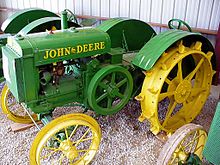
John Deere Model D tractor
Despite a rather severe farm economy depression at the time, Deere & Company direction decided to build the Model D prototype in 1923, designed by Muir L. Frey (begetter of Ford Mustang designer Donald Due north. Frey).[2] The Deere Model D was produced from March i, 1923, to July 3, 1953, the longest product bridge of all the 2-cylinder John Deere tractors. Over 160,000 were fabricated.[3]
The first Model D rode on steel wheels with a 6.5 by vii inches (xvi.v past 17.8 centimetres) (later on half-dozen.75 by 7 inches (17.1 by 17.viii centimetres)) two-cylinder hand-cranked engine rated 15 to 27 horsepower (eleven to 20 kilowatts).[three] It was not, however, the first tractor to bear the Deere proper name; as a number of Deere experimental tractors, and the John Deere Dain all-wheel drive tractor (of which approximately 100 were produced during 1918 and 1919) had all carried the Deere proper name before the Model D.
By 1925, Deere & Company realized the standard Model D did not meet customers' needs for industrial applications. Steel wheels were not suitable for hard surfaces, and the gearing was as well wearisome for rubber route speeds. Solid rubber tires were added, and engineers fitted a 28 tooth sprocket to the terminal drive, giving a road speed of four mph (vi.4 km/h). The company replaced the 465 cu in (vii.62 fifty) two-cylinder engine with a 501 cu in (8.21 fifty). In 1926, Deere & Visitor advertised the model as the "John Deere industrial tractor", with twoscore in × viii in (101.6 cm × 20.3 cm) rear wheels and 24 in × iii.5 in (61.0 cm × 8.ix cm) fronts with solid tires. This became known as the "DI". Options besides included bike weights.[iv]
GP tractor [edit]
On June 20, 1928, the model designation was changed from "C" to "GP", to avoid confusion with the "D" when dealers were phoning in orders to the factory. "GP" stands for "general purpose". This new model GP had the same horsepower, engine displacement, weight, and 3-speed transmission as the model C. The GP's outset serial number was 200211. In 1930, the GP was updated with a 25 horsepower (19 kilowatts), 339 cubic inches (5.56 litres) engine.
The John Deere Model GP was built in 5 distinct versions through the course of its production:
- The standard-front GP, or John Deere standard, built from March 1928 to February 1935
- The John Deere 2-wheel tricycle-front GP, or GP-tricycle, of which 20-3 units were congenital between Baronial 1928 and Apr 1929
- The John Deere GP wide-tread, or GPWT, congenital from Nov 1929 to November 1933
- The John Deere GP wide-tread Serial P, a GPWT with narrowed rear tread width designed to suit potato rows, built between January and August 1930
- The John Deere general purpose orchard tractor, or "GPO", from Apr 1931 to April 1935. This tractor had specialized shielding for groves and orchards and effectually low-hanging branches. Some GPOs were fitted with crawler undercarriages from the Lindeman Brothers in Yakima, Washington. These are unremarkably known as "GPO Lindemans".
The John Deere Model A came off the associates line in April 1934. The tractor was 25 horsepower (19 kilowatts), was 309 cubic inches (v.06 litres), and had a four-speed transmission. There were viii unlike model A variations. Some of these were tricycle, hi-ingather, orchard, single front tire, and industrial models. The tricycle wheel blueprint, patterned after that of the Farmall tractor, reduced steering effort, and greatly increased maneuverability. The Model B was introduced in June 1934. This tractor had a shorter frame than the Model A, only it was somewhen lengthened and then it could use some of the aforementioned equipment that the larger models A and Yard used. There were likewise 8 different Model B tractor variations, the same as the larger Model A.
The much larger G model arrived in 1937. It was fitted with a 36 horsepower (27 kilowatts), 425 cubic inches (6.96 litres) engine, and a 4-speed transmission. Deere & Visitor publicized the M as a three-plow tractor, and it was built until 1941, when the GM (G, modernized) replaced it. The GM model was fabricated from 1942 to 1947. The drawbar power increased to 38 horsepower (28 kilowatts), and a new six-speed manual was also added. The Thousand model got a restyled front at this point, equally did the other John Deere tractor models. The GM had electric starting and lighting added to its options. During its production fourth dimension, the G tractor was available as a howdy-crop, single forepart wheel, and styled.
United nations-styled row ingather tractors [edit]
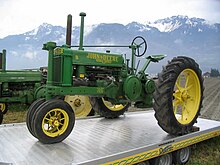
John Deere Model B tractor
Deere & Company made their first united nations-styled row crop tractor in 1929, to compete with the Farmall. It was a modified GP tractor, with adjustable rear axle track (altitude between wheels on the same axle), and a narrow front end end. In 1933, Deere & Company started experimenting with what would come to be known every bit the Model A. The new Model A went into product in 1934. The A launched John Deere into the row ingather farming marketplace. The A was by far the near popular two-cylinder tractor that Deere & Company produced. The next twelvemonth the Model B was introduced. It was one third smaller than the A, which made it ideal for smaller farms. A few years later, the Model G was introduced in 1937. It remained un-styled for several more years than the A and B. The un-styled tractors launched Deere & Company into the row crop farming market place which they are yet a major function of today.
The Deere & Visitor very nearly went bankrupt in the Great Depression. Only a large social club of tractors for the Soviet Spousal relationship kept the company going.
Streamlined look [edit]
In 1937, John Deere hired well known industrial designer Henry Dreyfuss from New York City to re-style Deere & Visitor's farm machinery, especially its tractors. In the fall of 1937, a John Deere tractor engineer was sent to New York to ask Dreyfuss to redesign the tractors. Fable has it that Dreyfuss was and then intrigued by the project, that he took a train to Waterloo that very night. Dreyfuss learned to operate the tractors, and worked with them in the field to gain firsthand cognition of the changes that needed to be fabricated. The beginning two letter serial tractors (the A and B) were the first to receive the new modern styling, and other models were added later on. The Dreyfuss styling was intended to assist Deere & Visitor compete with the forthcoming Farmall "letter series" of tractors, which, along with the Ford-Ferguson, were John Deere'south largest competition at this time. Dreyfuss and the Waterloo engineers perfected the styled pattern that was used on all John Deere tractors, with but pocket-size changes through to 1959.
The 1930s and 1940s saw a large number of dissimilar John Deere models emerge, as small farmers emerging from their Depression troubles increasingly turned from horses to tractors. Deere & Company's GM model was introduced in 1942, and was made until 1947. Engine power was increased to 38 horsepower (28 kilowatts), and a new six-speed manual was also added. The G model got a restyled forepart at this betoken, as did the other John Deere tractors models. The GM had electrical beginning and lights added to its options. During its product time, the G tractor was available in hi-crop and unmarried front bike versions. The One thousand was restyled in 1941, just did not get-go to ringlet off the assembly line until early 1942. Like the smaller A and B tractors, the G model had the six-speed transmission added to information technology. In 1946, the 1946 model "D" had a 501 cubic inches (8.21 litres) engine, which was enormous for the day. Two new additions to the tractor line, the M and R models, were also added.
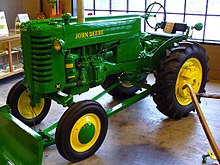
John Deere Model Thou tractor
After the models A and B got new styling, both tractors were given vi-speed transmissions in late 1940. The A was 29 horsepower (22 kilowatts) out of a 321 cubic inches (5.26 litres) engine, while the smaller B was both 18 and 23 horsepower (xiii and 17 kilowatts), reflecting the earlier and later updates betwixt 1938 and 1946. The 14.84 Model H was given the Dreyfuss look from the fourth dimension it was introduced in 1938. The H broke a fuel economy record when it was tested in Nebraska. This tractor also had iii variations that came out in 1940–1941. The H tractor was 14.84 horsepower (11.07 kilowatts) out of a 90 cubic inches (one.5 litres) engine, and had a 3-speed transmission.

Model AW (1947-52, late styled) in original condition, Gulgong museum, NSW Australia
In 1939, the restyled Model D appeared. The D was a 42 horsepower (31 kilowatts) tractor, and weighed 5,300 pounds (2,400 kilograms). Options available on this tractor included electric lighting and starting. In August 1940, Deere & Company introduced the new model LA which was followed by the model LI. The LA had a 77 cubic inches (1.26 litres) engine with 14 belt horsepower. The John Deere M tractor was restyled in 1941, but did not start to roll off the assembly line until early 1942. Similar the smaller A and B tractors, the Grand model also had the six-speed transmission, but also featured electric lights and electric starting time.
In 1947, Deere & Company opened a new tractor factory in Dubuque, Iowa, built to produce the John Deere Model 1000. The M was created to address the increasing need for small tractors, and compete with the increasingly pop Ford, and the smaller Farmall tractor models. The Grand was the first John Deere tractor to use a vertical ii-cylinder engine, with a square diameter to stroke ratio of 4.0 by 4.0 inches (ten.2 by x.2 centimetres) 100.v cubic inches (ane,647 cubic centimetres) with a high row crop.
1949–1959: diesels and post World State of war 2 production [edit]

John Deere Model 60 (1955)

John Deere Model 530 (1959)

John Deere Model 430S (circa 1960)
Later on years of testing, Deere & Company released its first proper diesel fuel engined tractor in 1949, the Model R. The R was too the first John Deere tractor with a alive independent power take-off (PTO) equipped with its ain clutch. The R also incorporated live hydraulics. PowrTrol, as it was known, provided the operator the ability to lift equipment by the pull of a lever. A pump powered by the PTO clutch provided ane,800 pounds per square inch (120 bars) of hydraulic pressure level to a lever controlled valve. At 45 horsepower (34 kilowatts) at the drawbar and 50 horsepower (37 kilowatts) at the chugalug, it was the near fuel-efficient tractor available at the time, and this combination of features resulted in over 21,000 being built. The Model R had a shipping weight of 7,670 pounds (3,480 kilograms). The R was equipped with two engines. The main engine is a 2-cylinder, 4-stroke, naturally-aspirated 416 cubic inches (six.82 litres) (5.75 by eight.00 inches (14.6 by xx.3 centimetres) bore and stroke), direct injected diesel engine, with a xvi:i compression ratio. The starting engine is besides a John Deere two-cylinder, 26 cubic inches (426 cubic centimetres) horizontally opposed gasoline engine. The starting or "pony" engine is electrically started past a half-dozen-volt electrical system, and is used to crank the main diesel engine. Testing results with diverse electrical starting systems for the diesel engine proved to be as well bulky, requiring a 24- or 32-volt organization. The design of the pony starter Model Rs allowed for hot exhaust gasses to preheat the intake air for the diesel fuel engine, and a common liquid cooling arrangement allowed the pony engine to warm the diesel engine cake and head. This provided sufficient cold weather starting aids for the diesel engine that it would reliably run in sub-zippo[ clarification needed ] weather. The R did accept several teething problems, as this was Deere & Company'south outset product diesel fuel engined tractor. Available equally a standard tractor simply, information technology did not take an adjustable forepart axle, nor did information technology accept a three-point hitch. The engine was mainly an up-scaled gasoline engine from the Model D. The use of a thermosiphon cooling arrangement, and the lack of a three-indicate begetting crankshaft proved inadequate for diesel engine pinch ratios. The R was prone to overheating, and cracking the cylinder head. The lack of a middle main bearing in the crankshaft allowed the crankshaft to flex when used as a stationary power-plant on the belt; this would lead to its failure. The live PTO was directed through ii 45° bevel gears that proved too pocket-size to durably transmit the full torque of the engine. The tractor was fully serviceable at pulling larger equipment efficiently on large acre wheat-country farms.
During the 1950s, the R saw a series of upgrades in the models fourscore, 820, and 830. The 80 was produced for two years, and 3,500 were produced. It had new features, including power steering and dual hydraulics. It developed 68 horsepower (51 kilowatts) and weighed 8,100 pounds (3,700 kilograms). The fourscore also corrected the other design flaws inside the R, such as using a water pump and radiator force per unit area cap, and the addition of a center crankshaft master bearing.
The 820 and 830 were similar overall, merely also differed in their sheet metal exteriors, fuel tank designs, and color schemes. The 820, a larger version of the 720 and the 720, was basically the same as the 70, except for the model number, and that the sides of the hood are painted John Deere yellow. The 720 was upgraded to the 730 for 1959. The 730 featured more than contoured bodywork than the 720, and came with more than ergonomic features for the operator. Although the 730 had a short production run, it became one of Deere & Company's nigh popular models. The 730 also featured power steering and 24-volt electrical starter motor, instead of the V4 pony starter engine. The 730 was available in diesel fuel, gasoline, and LPG, as well as in row crop tricycle, row crop broad front, standard tread, and howdy crop wide front formats. The 730 is very popular with tractor pulling enthusiasts, because of its weight, power, and slow speed. The 730 was a 59 horsepower (44 kilowatts) tractor at the chugalug and 54 horsepower (twoscore kilowatts) at the drawbar.
After making more than than i and a quarter (1 ¼) million two-cylinder tractors, Deere & Company switched to 4- and 6-cylinder engines. Declaration of the change came after seven years of evolution, and forty million dollars in retooling.
In Oct 1959, the visitor showcased a new large 215 horsepower (160 kilowatts) iv-cycle drive (4WD), called the 8010, on the Robert Ottilie Seed Farm north of Marshalltown, Iowa. It was shown during the largest farming field days event held in Iowa up to that time. But ane-hundred 8010s were built, and 99 of those were rebuilt at the factory, and re-released as 8020s in 1960.
1960s: new generation [edit]

To introduce its new generation tractors to all of its dealers in a single mean solar day, Deere & Visitor chartered aeroplanes to fly more than than 5,000 people to Dallas, Texas, on August 30, 1961. Deere & Company put their new tractors on brandish outside the Cotton Bowl, and within Neiman Marcus. The day marked the release of a revolutionary line of farm tractors, with sleek new styling by Henry Dreyfuss, that would shortly go the standard by which all other farm tractors would be measured.[5] These tractors were the 1010, 2010, 3010 and 4010.
These were soon followed by the model 5010 standard introduced in 1962. The 5010 was the commencement two-bicycle drive to exceed 100 horsepower (75 kilowatts) at the PTO and drawbar. Designed for the western wheat-lands, the 5010 was never available as a row ingather model. In 1963, the 3010 and 4010 were replaced by the 3020 and 4020. The 4020 is one of the most pop tractors Deere & Visitor has always made. The twelvemonth 1965 brought the 5020 standard, which was the industry's most powerful two-wheel-drive model, along with the 1020, 2020, and 54 horsepower (twoscore kilowatts) model 2510. By 1966, the 4020 accounted for 48% of all John Deere tractor sales.[6] Likewise that yr, a row ingather version of the 5020 was introduced.
In the late 1960s, Deere & Visitor pioneered the gyre-over protection structure to protect the driver from injury in the result of a tractor roll-over. John Deere invited the competition to view a sit-in of its new Roll-Guard. Deere recommended that all tractors include this safety feature, and offered to share its design and test data with its competitors. Deere & Company also encouraged farmers to retro-fit their tractors with this safety characteristic, and offered roll guards at cost to farmers who wished to install them on their older new generation tractors.
In 1968, nine new models appeared: the 820, 920, 1120, 1520, 2120, 2520, 4000, 4520, WA-14, and WA-17. The WA-xiv and WA-17 were articulated four-wheel-drive tractors. The 4520 was Deere & Company's kickoff turbocharged tractor. The 3020 and 4020 were updated with new features, and the 5020 model had a drawbar power increment to an manufacture leading 141 horsepower (105 kilowatts). The 4000 was a loftier horsepower-to-weight tractor, designed to be a "runner" rather than a "lugger". The 4000 used the same engine every bit the popular 4020, merely weighed almost i,000 pounds (450 kilograms) less. According to Deere & Visitor, the 4000 could, in the aforementioned amount of time, pull a 4-bottom plow fast enough to comprehend the aforementioned acreage equally a 4020 pulling a five-bottom plow. The John Deere 4000 was besides an economy tractor, providing the same horsepower every bit the 4020, with fewer features and smaller rear axles.
1970s: Generation Two [edit]
During the 1970s, Deere & Company introduced 36 new models. In 1972, John Deere introduced the Generation Ii tractors. Generation 2 was characterized past the optional Sound Baby-sit body, which was the first truly successful integrated tractor cab. This innovative cab was isolated from the tractor by big rubber bushings, which dampened vibrations, and the interior was insulated with foam to reduce noise, and protect the operator from farthermost temperatures exterior. A foam pad on the firewall and sheets of lead under the dash greatly reduced engine dissonance within the cab. The Sound Baby-sit body also featured a rounded front windshield with an integrated door. The door mail service was in line with the exhaust and air intake pipes, which road through the hood for the all-time forward visibility possible. Fully integrated heating and air conditioning was standard equipment, and it also featured windshield wipers, a dome lite, a red interior lamp to illuminate the gear shift levers and hydraulic controls during nighttime operation, and speakers for an optional AM/FM radio, which many farmers added because they found the cab and so tranquility they could actually hear it. When it was introduced, information technology was the quietest tractor cab in the industry, and a vast improvement over the aftermarket cabs that Deere & Company had previously retrofitted to its tractors.
The Generation 2 tractors also offered other innovative features not available on previous John Deere models, such every bit a Quad Range transmission that improved on Deere'south proven Synchro Range manual, past adding a loftier and depression gears in each range, and Deere's new Perma-Clutch; a wet clutch that would final much longer, most the life of the tractor.
- 1970, the 116 horsepower (87 kilowatts) 4320, the 135 horsepower (101 kilowatts) 4620, and 146 horsepower (109 kilowatts) 7020 were introduced;
- 1970 in Argentine republic, introduced the local-made xx series, with the 1420,[7] 2420,[8] 3420,[ix] and 4420;[10]
- 1971, the 60 horsepower (45 kilowatts) 2030, the 175 horsepower (130 kilowatts) 6030, and 7520 (also at 175 horsepower (130 kilowatts)) were added;
- 1972, on Saturday August 19, John Deere dealers held an open house to usher in their 'Generation II' tractors. The four new tractors were the 80 horsepower (60 kilowatts) 4030, 100 horsepower (75 kilowatts) 4230, 125 horsepower (93 kilowatts) 4430 and 150 horsepower (110 kilowatts) 4630; there were billed as "Sound Thought" tractors because of their innovative Sound Baby-sit Body operators enclosure;
- 1973 would meet the final New Generation utility tractors launched; the 35 horsepower (26 kilowatts) 830, 45 horsepower (34 kilowatts) 1530, and 70 horsepower (52 kilowatts) 2630;
- 1974, the starting time two models in the Generation Ii 4-wheel drive range appeared in 1974 in the 215 horsepower (160 kilowatts) 8430 and 275 horsepower (205 kilowatts) 8630;
- 1975 in Argentine republic, the 30 series was launched with the 2330,[11] 2530,[12] 2730,[thirteen] 3330,[14] 3530,[15] and 4530;[sixteen]
- 1975, the initial Generation II utility tractors were introduced; these were the 40 horsepower (30 kilowatts) 2040, 50 horsepower (37 kilowatts) 2240, 60 horsepower (45 kilowatts) 2440, and 70 horsepower (52 kilowatts) 2640;
- In late 1976, a new 80 horsepower (60 kilowatts) addition as the 2840;
- 1977 saw what came to be known as "Seven in '77"; Deere & Company's first meaty diesels, the John Deere "Task Master" tractors, were introduced in the 22 horsepower (16 kilowatts) 850 and 27 horsepower (twenty kilowatts) 950; other than that, the big news was what Deere & Company called "The New Iron Horses", with more than horses and more iron; these were the 90 horsepower (67 kilowatts) 4040, 110 horsepower (82 kilowatts) 4240, 130 horsepower (97 kilowatts) 4440, 156 horsepower (116 kilowatts) 4640, and the 180 horsepower (130 kilowatts) 4840, which replaced the 6030. The "Atomic number 26 Horses" featured an improved Audio Guard Body with more sound proofing, hydraulic seat suspension, and Deere's Personal Posture seat equally standard equipment. The 4240, 4440, 4640, and 4840 featured a new engine;
- 1978 brought the 215 horsepower (160 kilowatts) 8440 and 275 horsepower (205 kilowatts) 8640 articulated 4 wheel drive tractors;
- 1979, tardily in the twelvemonth, a 3rd diesel compact was added, the 33 horsepower (25 kilowatts) 1050; it had a turbo diesel engine which was unique in its form. 5 new utility tractors were added at the same time, the 41 horsepower (31 kilowatts) 2040, l horsepower (37 kilowatts) 2240, sixty horsepower (45 kilowatts) 2440, 70 horsepower (52 kilowatts) 2640, and 81 horsepower (sixty kilowatts) 2940; these five new models had a black and yellow "tiger stripe" on both sides of the hood;
- 1979 was the get-go yr for the 40 series in Argentina, because the offset model are the John Deere 3440,[17] and continues in the 1980s with the 2140,[18] 3140 / 3140 DT,[19] 3540.[xx]
1980s [edit]
Deere & Company introduced at least 38 new tractors during the 1980s, during a time when at to the lowest degree three other competitors merged, were sold, or went out of business birthday:
- Ii new small compact diesel tractors were added in 1981; these were the PTO xiv.5 horsepower (ten.8 kilowatts) 650 and PTO 18 horsepower (13 kilowatts) 750. Three new 4WDs came to market in the fall of 1981; these were the 225 horsepower (168 kilowatts) 8450, 290 horsepower (220 kilowatts) 8650, and large 370 horsepower (280 kilowatts) 8850; the 8850 came with the company's biggest engine, the 955 cubic inches (xv.65 litres) V8 engine;
- As well the 8850, the John Deere 844 bicycle loader and 990 hydraulic excavator were the only other John Deere products to get this V8 engine; also according to Wayne Broehl'due south 1984 book, about the John Deere's Company, a larger 4WD tractor than the 8850 was supposed to appear but never did;
- In 1982, 11 new 50 serial tractors from 40 horsepower (30 kilowatts) up to 192.99 horsepower (143.91 kilowatts) debuted. The 40 horsepower (xxx kilowatts) 1250, 45 horsepower (34 kilowatts) 2150, 55 horsepower (41 kilowatts) 2350, 65 horsepower (48 kilowatts) 2550, 75 horsepower (56 kilowatts) 2750, 85 horsepower (63 kilowatts) 2950, 100 horsepower (75 kilowatts) 4050, 120 horsepower (89 kilowatts) 4250, 140 horsepower (100 kilowatts) 4450, 165 horsepower (123 kilowatts) 4650, and 192.99 horsepower (143.91 kilowatts) 4850. From the 2150 to the 4850 got some other manufacture leading innovation, in the use of castor action mechanical front-bicycle bulldoze, which provided 20 per centum more pulling ability. Similar the front tires of a motor grader, this brush action Mechanical Forepart Cycle Drive (MFWD) had the front tires lean to give a shorter turning radius. John Deere's l Series tractors likewise offered a new ability shift transmission, with 15 operating speeds. When tested in Nebraska, the 4850 was the near fuel efficient tractor ever tested over 60 horsepower (45 kilowatts).;
- The following year, 1983 brought in the final two 50 Serial tractors namely the 50 horsepower (37 kilowatts) 1450 and sixty horsepower (45 kilowatts) 1650. When tested in Nebraska, the 1650 proved to exist the most fuel efficient tractor ever tested. A 4020 shadow, namely the 95 horsepower (71 kilowatts) 3150 came nearly in 1985. This was the first John Deere row crop tractor to have MFWD every bit standard equipment.;
- Iii new diesel compacts came to light in 1986; these were the 16 horsepower (12 kilowatts) 655, twenty horsepower (15 kilowatts) 755, 24 horsepower (xviii kilowatts) 855 and 900HC. The 900HC was offset like the 2-cylinder M, and was for niche markets. The 655, 755, and 855 all had a hydrostatic drive transmission. The 2355, 2555, 2755, and 2955 were featured as cost fighter (economic system) tractors in 1986 with less features.;
- The post-obit year, 1987 Deere & Company brought out six new models in the 45 horsepower (34 kilowatts) 2155, 55 horsepower (41 kilowatts) 2355, 65 horsepower (48 kilowatts) 2555, 75 horsepower (56 kilowatts) 2755, 85 horsepower (63 kilowatts) 2955, and 96 horsepower (72 kilowatts) 3155;
- In October 1988, at the dealer meeting in Denver, Colorado, the new 235 horsepower (175 kilowatts) 8560, 300 horsepower (220 kilowatts) 8760, and 370 horsepower (280 kilowatts) 8960 were introduced;
- In early 1989, in Palm Springs, California, half-dozen new 55 Series tractors were shown to dealers; these were the 105 horsepower (78 kilowatts) 4055, 120 horsepower (89 kilowatts) 4255, 140 horsepower (100 kilowatts) 4455, 156 horsepower (116 kilowatts) 4555, 177 horsepower (132 kilowatts) 4755, and 202 horsepower (151 kilowatts) 4955; the 4555 was an entirely new model which was the same size every bit the 4640;
- This year also brought the 70 Series gear driven compact diesels; these were the 18 horsepower (13 kilowatts) 670, 24 horsepower (18 kilowatts) 770, 28 horsepower (21 kilowatts) 870, 33 horsepower (25 kilowatts) 970, and 38 horsepower (28 kilowatts) 1070.
1990s and Generation Iii [edit]
- In 1990, Deere & Company introduced a new hydrostatic compact utility tractor: the 955 with a 33 horsepower (25 kilowatts) three-cylinder diesel engine.
5000 series [edit]
In what some industry watchers were calling Generation III, the year 1991 brought a glimpse of what Deere & Company tractors of the 1990s would be like. Eight new John Deere tractors were introduced in 1991, starting with the three 5000 Series tractors. These were the twoscore horsepower (30 kilowatts) 5200, l horsepower (37 kilowatts) 5300, and 60 horsepower (45 kilowatts) 5400. Ii new models, the 92 horsepower (69 kilowatts) 3055, and 100 horsepower (75 kilowatts) 3255 followed.
Deere & Visitor is manufacturing 5000 Series of tractors at Sanaswadi, Pune, in India; the range of products from India are listed below. Additionally, the paint schemes changed in 2007. In 2007, Deere & Visitor fabricated some horsepower rating changes in otherwise unchanged machines. The 5103 came with a black engine and driveline prior to 2007, when they began painting the engine area all green. These are referred to as black belly's or greenish abdomen's. The black belly 5103 was rated at 50 horsepower (37 kilowatts), while as is listed beneath the green belly 5103 was rated at 40 horsepower (30 kilowatts).
- 5036C – 35 horsepower (26 kilowatts)
- 5041C – 41 horsepower (31 kilowatts)
- 5103 Economy – 35 horsepower (26 kilowatts)
- 5038D – 38 horsepower (28 kilowatts)
- 5103 – 40 horsepower (30 kilowatts)
- 5103S – 42 horsepower (31 kilowatts)
- 5104 – 45 horsepower (34 kilowatts)
- 5203S – 50 horsepower (37 kilowatts)
- 5204 – 50 horsepower (37 kilowatts)
- 5210 – 45 horsepower (34 kilowatts)
- 5310 – 55 horsepower (41 kilowatts)
- 5310 MFWD – 55 horsepower (41 kilowatts)
- 5410 – 65 horsepower (48 kilowatts)
- 5510 MFWD – 75 horsepower (56 kilowatts)
threescore series [edit]
For 1992 model year, Deere & Visitor introduced the 160 horsepower (120 kilowatts) 4560, the 175 horsepower (130 kilowatts) 4760, and 202 horsepower (151 kilowatts) 4960. They were nearly identical to the 4555, 4755, and 4955 they replaced, with the improvements being improved lighting and safe,[21] hood free of the air intake and exhaust piping, which was moved to the right corner mail service of the cab on the lx Series tractors, and an improved cab entry step with handrail.
6000 and 7000 series [edit]
In the autumn of 1992, six totally new 6000 and 7000 Series tractors were introduced by Deere & Company;[22] the 62 horsepower (46 kilowatts) 6200, 75 horsepower (56 kilowatts) 6300, 85 horsepower (63 kilowatts) 6400, 110 horsepower (82 kilowatts) 7600, 125 horsepower (93 kilowatts) 7700, and 146 horsepower (109 kilowatts) 7800. Also the cabs were completely redesigned for better visibility and operator comfort; John Deere's new cabs were a significant comeback over the Sound Guard body which had set the manufacture standard for ii decades.
lxx serial [edit]
The spring of 1993, Deere & Company introduced the four new 70 Series Power Plus 4WD models; these were the 250 horsepower (190 kilowatts) 8570, 300 horsepower (220 kilowatts) 8770, and a new model, the 350 horsepower (260 kilowatts) 8870. And the first 400 horsepower (300 kilowatts) tractor, the 8970. These tractors were equipped with an electronic power burl that would kick in when tough field conditions were encountered. After in the summertime, the 3055 and 3255 were replaced with the 92 horsepower (69 kilowatts) 7200 and 100 horsepower (75 kilowatts) 7400.
8000 series [edit]
1994 was a red letter of the alphabet yr in tractor evolution for Deere & Company, because that year brought about the most revolutionary row crop tractors the industry had seen up to then. 1994 was the last year of the Sound Guard body from John Deere, with the concluding one congenital being a 2WD 4760 model. It was manufactured on 1994 May 25. This concluded a 22-yr run for Sound Guard tractors, that were widely regarded as the nigh successful tractors ever built.
- The new 8000 Serial tractors were introduced with country-of-the-fine art features; the 160 horsepower (120 kilowatts) 8100, 180 horsepower (130 kilowatts) 8200, 200 horsepower (150 kilowatts) 8300, and 225 horsepower (168 kilowatts) 8400. 1 lone utility tractor, the 73 horsepower (54 kilowatts) 5500 was added in the fall of 1995.
Ten series upgrades [edit]
1996 saw thirteen (13) new tractors debuted at a big John Deere dealer meeting in New Mexico.
- First, all of the 7000 Serial tractors were replaced the five 7000 X series tractors; these were the 95 horsepower (71 kilowatts) 7210, 105 horsepower (78 kilowatts) 7410, 115 horsepower (86 kilowatts) 7610, 130 horsepower (97 kilowatts) 7710, and 150 horsepower (110 kilowatts) 7810;
- Only the large news came with the 8000T Serial safety belted track tractors; at that place were the 8100T, 8200T, 8300T, and 8400T; these built upon the 8000 Series wheeled tractors;
- The 70 Serial tractors were replaced by the iv 9000 Series tractors, at 260 horsepower (190 kilowatts), 310 horsepower (230 kilowatts), 360 horsepower (270 kilowatts), and 425 horsepower (317 kilowatts); these were the 9100, 9200, 9300, and 9400;
- 1997 brought vii new tractors, three in the Reward Series, and four in the 5000 Ten series models. The three Advantage models were the 85 horsepower (63 kilowatts) 6405, 95 horsepower (71 kilowatts) 6605, and 105 horsepower (78 kilowatts) 7405. The 45 horsepower (34 kilowatts) 5210, 55 horsepower (41 kilowatts) 5310, 65 horsepower (48 kilowatts) 5410, and 75 horsepower (56 kilowatts) 5510 represent the 5000 TEN series tractors.;
- The spring of 1998 revealed the iv 6000 TEN tractors;[22] the 65 horsepower (48 kilowatts) 6110, 72 horsepower (54 kilowatts) 6210, 80 horsepower (lx kilowatts) 6310, and ninety horsepower (67 kilowatts) 6410. Another new addition to the long light-green range in 1998 was the six 4000 Series compact diesel fuel engined tractors; these were the 20 horsepower (15 kilowatts) 4100, 21.five horsepower (16.0 kilowatts) 4200, 32 horsepower (24 kilowatts) 4300, 36 horsepower (27 kilowatts) 4400, 39 horsepower (29 kilowatts) 4500, and 43 horsepower (32 kilowatts) 4600. An Advantage Series 30 horsepower (22 kilowatts) 790 meaty diesel engined tractor was also added.
T tracked versions [edit]
During the fall of 1998, Deere & Visitor had a 360 horsepower (270 kilowatts) prototype 9300T track tractor at at least three subcontract shows. During Baronial 1999, the company had another dealer meeting in Moline, Illinois. It was hither that the 360 horsepower (270 kilowatts) 9300T, and 425 horsepower (317 kilowatts) 9400T were revealed to their John Deere dealers. A 115 horsepower (86 kilowatts) 7510 with full four-cycle drive was added. As a consequence, the 7610 was uprated to 120 horsepower (89 kilowatts), and 7710 up to 135 horsepower (101 kilowatts). The 8000/8000T Series tractors were replaced with the 165 horsepower (123 kilowatts) 8110/8110T, 185 horsepower (138 kilowatts) 8210/8210T, 205 horsepower (153 kilowatts) 8310/8310T, and 235 horsepower (175 kilowatts) 8410/8410T.
2000s [edit]
- In the Meaty utility sector, the John Deere 790 at 27 horsepower (20 kilowatts), like to the previous 770, and the 990 at 41 horsepower (31 kilowatts) were introduced by Deere & Company. The 990 was a combination of the quondam 1050 and the previous 970. They would last until 2007, at which time John Deere re-badged them. They be in 2012 every bit the 3005 (790) and the 4005 (990). In the compact and now subcompact segment, these are all that is left that is not hydrostatic.;
- The year 2000 was not an active year for new Deere & Company tractor launches, but did yield the 48 horsepower (36 kilowatts) 4700. But the year 2001 produced thirty-two (32) new green-and-yellow tractors. Starting with the twoscore horsepower (thirty kilowatts) 990 Advantage Serial compact diesel tractor, this was only the showtime. Two new 5005 Series Advantage were also added; these were the 45 horsepower (34 kilowatts) 5105 and 53 horsepower (forty kilowatts) 5205.;
- Early on in 2001, Deere & Visitor introduced the 5020 Series utility tractors; these were the 45 horsepower (34 kilowatts) 5220, 55 horsepower (41 kilowatts) 5320, 65 horsepower (48 kilowatts) 5420, and 75 horsepower (56 kilowatts) 5520. But the big news for Deere & Visitor came in August 2001, in a John Deere dealer coming together in Albuquerque, New Mexico, where twenty-iv (24) new tractors from 65 to 450 horsepower (48 to 336 kilowatts) were introduced; specifically, these were the 6003, 6020, 8020/8020T, 9020, and 9020T Series tractors.;
- These were the 85 horsepower (63 kilowatts) 6403, 95 horsepower (71 kilowatts) 6603, 65 horsepower (48 kilowatts) 6120, 72 horsepower (54 kilowatts) 6220, 80 horsepower (60 kilowatts) 6320, 90 horsepower (67 kilowatts) 6420, in the smaller 6000 Series tractors;
- In the row ingather tractor, the ten models were the 170 horsepower (130 kilowatts) 8120/8120T, 190 horsepower (140 kilowatts) 8220/8220T, 215 horsepower (160 kilowatts) 8320/8320T, 235 horsepower (175 kilowatts) 8420/8420T, and 256 horsepower (191 kilowatts) 8520/8520T. As has been the instance since 1996, Deere & Company has been the only visitor to offer row crop tractors in both wheel and prophylactic tracks.;
- Deere & Company replaced the 9000 Series 4WD with the 280 horsepower (210 kilowatts) 9120, 325 horsepower (242 kilowatts) 9220, 375 horsepower (280 kilowatts) 9320/9320T, 425 horsepower (317 kilowatts) 9420/9420T, and the largest John Deere tractor in history up to that point, the 450 horsepower (340 kilowatts) 9520/9520T. The 8020/9020 tractors have features like independent link suspension and ActiveSeat, to give the driver a more comfortable and productive day in the field.
4000 TEN upgrade [edit]
- 2002, Deere & Visitor introduced nine new 4000 X Series tractors;
- 1st quarter, the 20 horsepower (15 kilowatts) 4110, 18 horsepower (xiii kilowatts) 4010, 20 horsepower (15 kilowatts) 4115, 28 horsepower (21 kilowatts) 4210, 32 horsepower (24 kilowatts) 4310, 35 horsepower (26 kilowatts) 4410, 39 horsepower (29 kilowatts) 4510, 44 horsepower (33 kilowatts) 4610, and 48 horsepower (36 kilowatts) 4710;
- 3rd quarter, the smaller 7020 Series tractors debuted; these went from 95 to 125 horsepower (71 to 93 kilowatts), and were the 95 horsepower (71 kilowatts) 7220, 105 horsepower (78 kilowatts) 7320, 115 horsepower (86 kilowatts) 7420, and 125 horsepower (93 kilowatts) 7520. Besides added were the 6015 Series, which were the 72 horsepower (54 kilowatts) 6215, 85 horsepower (63 kilowatts) 6415, 95 horsepower (71 kilowatts) 6615, and 105 horsepower (78 kilowatts) 6715.;
- In early 2003, an IVT manual was added to the options for the 7710 and 7810 tractors; a new 22 horsepower (16 kilowatts) 2210 meaty diesel engined tractor was too added;
- 2003, in Baronial, Deere & Company held a big John Deere dealer meeting in Columbus, Ohio; three new 5003 tractors were released, the 44 horsepower (33 kilowatts) 5103, 53 horsepower (40 kilowatts) 5203, and 64 horsepower (48 kilowatts) 5403.
500 hp models make it [edit]
Ane thing the John Deere dealers in attendance at Columbus saw that did not appear at 'Deere.com' until March 2004 was the new 500 horsepower (370 kilowatts) 9620. The 9620 came after two of Deere & Visitor competitors introduced 500 horsepower (370 kilowatts) 4WDs.
seven×20 series [edit]
In Columbus, Ohio, Deere & Company announced the replacement of the three larger 7000 X tractors; namely the 140 horsepower (100 kilowatts) 7720, 155 horsepower (116 kilowatts) 7820, and the new 170 horsepower (130 kilowatts) 7920; the 7610 was discontinued.
- 2004 brought the 36 horsepower (27 kilowatts) 4120, 40 horsepower (30 kilowatts) 4320, 47 horsepower (35 kilowatts) 4520, and 52 horsepower (39 kilowatts) 4720. October had the 5025 Series utility tractor introduced; these were the 45 horsepower (34 kilowatts) 5225, 55 horsepower (41 kilowatts) 5325, 65 horsepower (48 kilowatts) 5425, and 75 horsepower (56 kilowatts) 5525.;
- In 2005, Deere & Company introduced fifteen (xv) new tractors; the offset models were the 3020 Series tractors; the 29.5 horsepower (22.0 kilowatts) 3120, 32.5 horsepower (24.2 kilowatts) 3320, 37 horsepower (28 kilowatts) 3520, and 41 horsepower (31 kilowatts) 3720; besides added was the PTO xviii horsepower (13 kilowatts) 2305;
- In the late summer, the 9320, 9420 and 9520 were fabricated into scraper specials to come across a niche market. The annual dealer convention was held in Fort Worth, Texas in Baronial 2005, where the company brought out the 8030/8030T Serial row ingather tractors; there were five wheeled models and three tracked models.;
- The following were introduced; the 180 horsepower (130 kilowatts) 8130, 200 horsepower (150 kilowatts) 8230, 225 horsepower (168 kilowatts) 8330, 250 horsepower (190 kilowatts) 8430, 277 horsepower (207 kilowatts) 8530, 200 horsepower (150 kilowatts) 8230T, 235 horsepower (175 kilowatts) 8330T, and 255 horsepower (190 kilowatts) 8430T; when tested in Nebraska the 8430 was tested as the most fuel efficient row crop tractor ever tested.[ commendation needed ]
2006 [edit]
The Deere & Company annual dealer meeting was held in Omaha, Nebraska; the launches included:
- The 32 horsepower (24 kilowatts) 3203, and 74 horsepower (55 kilowatts) 5403;
- The Omaha get together produced the smaller 6030 Premium, and the larger 7030 Serial tractors;
- 6030 Serial of the 75 horsepower (56 kilowatts) 6230, 85 horsepower (63 kilowatts) 6330, and 95 horsepower (71 kilowatts) 6430;
- 7030 Series of the 140 horsepower (100 kilowatts) 7630, 152 horsepower (113 kilowatts) 7730, 165 horsepower (123 kilowatts) 7830, and 180 horsepower (130 kilowatts) 7930.
2007 [edit]
In 2007, Deere & Company released thirty-two (32) new tractor models; the twelvemonth began with the introduction of the 5603 and 5625, both these are 82 horsepower (61 kilowatts), and are a further extension of the 5003 and 5025 Series tractors.
- A new series of 5003 tractors launched in the summer, consisting of the 38 horsepower (28 kilowatts) 5103, 47 horsepower (35 kilowatts) 5203, 55 horsepower (41 kilowatts) 5303, and 64 horsepower (48 kilowatts) 5403.
The Deere & Company large coming together was held in August 2007 in Cincinnati, Ohio; the John Deere dealers saw four new plant nursery and greenhouse tractors, which would not appear on the 'Deere.com' website until February 5, 2008; these would be the:
- 21 horsepower (sixteen kilowatts) 20A, 76 horsepower (57 kilowatts) 76F, 83 horsepower (62 kilowatts) 85F, and 96 horsepower (72 kilowatts) 100F; PTO horsepower on these four tractors are 17 horsepower (13 kilowatts), 66 horsepower (49 kilowatts), 73 horsepower (54 kilowatts), and 83 horsepower (62 kilowatts) respectively.
At the Cincinnati dealer meeting, the dealers also saw the regular 6030 / 7030, and the Premium 6030 Serial tractors:
- The 75 horsepower (56 kilowatts) 6230, 85 horsepower (63 kilowatts) 6330, 95 horsepower (71 kilowatts) 6430, 100 horsepower (75 kilowatts) 7130, 110 horsepower (82 kilowatts) 7230, and 125 horsepower (93 kilowatts) 7330; the only divergence betwixt the 2 series was that the Premium Series had the 140 horsepower (100 kilowatts) 7430;
- But the biggest tractors seen in this Cincinnati coming together were the 9030 Series 4WD tractors between 325 to 530 horsepower (242 to 395 kilowatts): the 325 horsepower (242 kilowatts) 9230, 375 horsepower (280 kilowatts) 9330, 425 horsepower (317 kilowatts) 9430/9430T, 475 horsepower (354 kilowatts) 9530/9530T, and 530 horsepower (400 kilowatts) 9630/9630T;
- The 280 horsepower (210 kilowatts) 9120 was discontinued;
- The 9430, 9530, and 9630 were also bachelor as scraper tractor models;
- The new meaty xl.4 horsepower (30.1 kilowatts) 4105 was in John Deere dealer lots in tardily December 2007.
2008 [edit]
In early 2008, Deere & Company introduced another compact diesel engined tractor, the 27 horsepower (20 kilowatts) 3005, which is substantially an updated John Deere 870. Followed by the new 31 engine PTO 23.five horsepower (17.5 kilowatts) 2720 subsequently in the twelvemonth.
On the back of the John Deere publication The Furrow (Summertime 2008) is a signup[ clarification needed ] for new equipment. Deere & Visitor had some other dealer meeting in belatedly July 2008, to introduce many new utility tractors. But the real announcement came with John Deere introducing a new worldwide numbering scheme for the entire range of meaty and agricultural tractors.
Power ratings / model numbers [edit]
From the 2008 model year range, Deere & Visitor nomenclature on the engine horsepower output for private models will now exist advertised in official literature and online using the metric system per the International Organization for Standardization (ISO) 97/68/EC standard for determining internet rated engine drawbar ability output; the metric horsepower value will exist used in the model name.
- The get-go digit volition state size;[ clarification needed ]
- The next three volition country rated engine output in metric horsepower;
- A new letter will be added (currently D, Due east, or Chiliad) to country specification level:
- R existence a high specification motorcar (like the Premium series in the 6000 and 7000 series);
- M to denote a mid specification;
- East/D to denote a low-specification, or "value specification", (like the 03 and 05 series in the 6000 and 5000 respectively);
- A sixth digit describes special configurations (like "T" for Tracks on the 8RT series tractors).
- Instance
For example, the new 3032E tractor will exist a 3000 with 32 horsepower (24 kilowatts) rated engine; the E is low-specification. This tractor represents the 2007 model year 3203 for its specification, non to be mistaken for the 3320 which has the same horsepower merely more features and at a higher toll. Over the side by side few years, all tractors will get this scheme. The issue is that Deere is using rated engine horsepower in the proper noun, not PTO horsepower, which is usually less.
2008 models (new nomenclature) [edit]
In 2008, the kickoff John Deere tractors to get the new naming scheme were the 5D, 5E, 5E Limited edition, and the 6D Series tractors. These tractors were introduced at the annual Deere & Company dealer meeting; this twelvemonth's effect was held in Denver, Colorado.
- 5D – range of the 45 horsepower (34 kilowatts) 5045D, and 55 horsepower (41 kilowatts) 5055D; the PTO horsepower ratings are 37 horsepower (28 kilowatts) and 45 horsepower (34 kilowatts) respectively; the 5D tractors are only available in two-wheel drive;
- 5E – range of the 45 horsepower (34 kilowatts) 5045E, 55 horsepower (41 kilowatts) 5055E, 65 horsepower (48 kilowatts) 5065E, and 75 horsepower (56 kilowatts) 5075E; the PTO horsepower ratings are the 37 horsepower (28 kilowatts), 45 horsepower (34 kilowatts), 53 horsepower (xl kilowatts), and 61 horsepower (45 kilowatts) respectively; the 5E Limited come with MFWD-mechanical front end-wheel drive;
- 5E Limited tractors – which are the 83 horsepower (62 kilowatts) 5083E, 93 horsepower (69 kilowatts) 5093E, and 101 horsepower (75 kilowatts) 5101E; the PTO horsepower ratings are 65 horsepower (48 kilowatts), 75 horsepower (56 kilowatts), and 82 horsepower (61 kilowatts) respectively; the 5E tractor are bachelor in both two-wheel drive and MFWD versions.
The biggest John Deere tractors in the new range were the 100 to 140 horsepower (75 to 104 kilowatts) 6D models.
- 6D – range of the 100 horsepower (75 kilowatts) 6100D, 115 horsepower (86 kilowatts) 6115D, 130 horsepower (97 kilowatts) 6130D, and 140 horsepower (100 kilowatts) 6140D; PTO horsepower for the four models are 82 horsepower (61 kilowatts), 95 horsepower (71 kilowatts), 105 horsepower (78 kilowatts), and 115 horsepower (86 kilowatts) respectively; the 6D is offered in ii-wheel drive and MFWD versions.
According to the 'Deere.com' website, Deere & Company introduced two new diesel engined 3E Series tractors. This pair of new 3E Series tractors is on folio two of The Furrow, December 2008 edition. Both new 3E models would announced in early October 2008. These would be the 31 / 25 horsepower (23 / 19 kilowatts) 3032E and 37 / xxx horsepower (28 / 22 kilowatts) 3038E. The 3032E is powered by a 97 cubic inches (1,590 cubic centimetres), while a 91 cubic inches (1,491 cubic centimetres) supply's the power on the 3038E. ProMagazine.com reports that this pair is for house owners who want a tractor that could take on everyday jobs, some features are: diesel engine, twin touch pedals, hydrostatic manual, standard 4WD, optional prowl command, ability steering, a power take-off (PTO) that is electronically engaged.
2009 models [edit]
On March 17, 2009, Deere.com announced the new 152 horsepower (113 kilowatts) 7530 Premium tractor.
During the calendar week of August 13, 2009, the company had some other large dealer meeting in Omaha, Nebraska, to introduce the new 8R/8RT row crop and track tractors to their dealers. On August 20, 2009, at Deere.com, a news release was posted on the 8R, 8RT, and two new 5105M specialty tractors. Vi new green-and-xanthous 8R row crop tractors 225 horsepower (168 kilowatts) 8225R, 245 horsepower (183 kilowatts) 8245R, 270 horsepower (200 kilowatts) 8270R, 295 horsepower (220 kilowatts) 8295R, 320 horsepower (240 kilowatts) 8320R, and the 345 horsepower (257 kilowatts) 8345R. PTO ratings are 181 horsepower (135 kilowatts), 198 horsepower (148 kilowatts), 220 horsepower (160 kilowatts), 242 horsepower (180 kilowatts), 263 horsepower (196 kilowatts), and 284 horsepower (212 kilowatts) respectively. The 8225R is the merely i available as a 2-wheel-drive model. Optional IVT or Powershift transmissions. In John Deere nomenclature, the first number equals size, the adjacent three numbers are the engine horsepower, and the alphabetic character at the finish stands for capability. The six tractors range from 225 to 345 horsepower (168 to 257 kilowatts), with the 8345R being the most powerful row crop model on the market. Besides shown to the dealers were the new 8RT prophylactic track tractor models. These three models are the 295 horsepower (220 kilowatts) 8295RT, 320 horsepower (240 kilowatts) 8320RT, and the 345 horsepower (257 kilowatts) 8345RT. The T at the end stands for tracks; other than that, the numbers in the 8RT Series are the same in their 8R counterparts. PTO horsepower for the three 8RT tractors are 239 horsepower (178 kilowatts), 260 horsepower (190 kilowatts), and 281 horsepower (210 kilowatts) respectively.
The 8RT models had their fuel capacity to 200 U.s.a. gallons (760 litres; 170 imperial gallons), and can come with track width upwards to 160 inches (410 centimetres). All ix 8R/8RT tractors are powered by the visitor's 548 cubic inches (eight.98 litres) PowerTech Plus six-cylinder diesel engine. 2 other bottom known tractors were also introduced past the company are the 5105ML orchard and poultry tractors. The horsepower is 105 horsepower (78 kilowatts) engine and PTO xc horsepower (67 kilowatts). One version of the 5105ML comes configured to piece of work in orchards and vineyards, while the other version is a low-profile tractor for work in poultry barns.
2010s [edit]
2010 models [edit]

In Baronial 2010, Deere & Company had another dealer meeting in Cincinnati, Ohio, to introduce even so more tractors. This was confirmed at Deere.com on August 26, 2010, with the announcement of more new 8R/8RT Series tractors. The new models are 2011 model yr tractors, with several improvements. These would be the 8235R, 8260R, 8285R, 8310R, 8335R, and 8360R bike tractors, ranging from 235 to 360 horsepower (175 to 268 kilowatts) rated engines. The PTO outputs are 192 horsepower (143 kilowatts), 213 horsepower (159 kilowatts), 234 horsepower (174 kilowatts), 250 horsepower (190 kilowatts), 276 horsepower (206 kilowatts), and 296 horsepower (221 kilowatts) for the six tractors. Besides the six bike tractors, three new 8RT track tractors would also be added. There would exist the 310 to 360 horsepower (230 to 270 kilowatts) rated engine 8310RT, 8335RT, and the 8360RT. Power-take off horsepower is 247 horsepower (184 kilowatts),268 horsepower (200 kilowatts), and288 horsepower (215 kilowatts) respectively. Ane of the major changes with these nine greenish-and-yellowish tractors was the new PowerTech PSX 548 cubic inches (8.98 litres) dual turbocharged diesel. This is an Acting Tier iv (IT4) diesel engine. On January i, 2011, EPA Tier 4 regulations began, thus the new PowerTech diesel in these tractors. Despite their competitors going with SCR to counter this, John Deere uses exhaust gas recirculation (EGR). To tell these new 8R tractors apart from the earlier 2010 tractors, John Deere put new wrap-effectually lights upwardly front. Also the model number has been moved shut to the front just off the blackness grill on both sides. Another feature is the new big black muffler on the right corner of the cab. Other improvements engineered into these tractors are JDLink, ActiveCommand Steering (ACS), Infinitely Variable Transmission (IVT) AutoMode, GS3 CommandCenter, and the StarFire 3000 receiver.
In a 2010 October meeting in Florida, John Deere dealers were shown the new 1023E and 1026E sub compact tractors that the company announced in February 2011.

2018 [edit]
In 2018, John Deere has the following tractors:[23]
- 9R, 9RT, 9RX - 4WD
- 6R, 7R, 8R, 8RT, 8RX - row crop
- 5090EL, 5075GL and 5125ML - specialty
- i, 2, iii, 4, 5, six series - utility
2020s [edit]
![[icon]](https://upload.wikimedia.org/wikipedia/commons/thumb/1/1c/Wiki_letter_w_cropped.svg/20px-Wiki_letter_w_cropped.svg.png) | This department is empty. You can assist by calculation to it. (March 2021) |
References [edit]
- ^ "Scale Models". world wide web.ScaleModelToys.com. Archived from the original on 2008-04-03. Retrieved 2008-07-02 .
- ^ Frey, Donald Due north. (September 1, 2009). "Innovation: What It Is All Near". www.AllBusiness.com. Engineering science Direction Journal. Retrieved 2010-03-30 .
- ^ a b Placard at Western Evolution Museum display.
- ^ Rukes, B (2002). John Deere Industrials. ISBN0-7603-1023-8.
- ^ "Deere Day in Dallas" (PDF). www.Deere.com. Deere & Company. Retrieved 2015-05-06 .
- ^ "Antiquarian farming, John Deere tractors". www.AntiqueFarming.com. Antique Farming. Archived from the original on 2008-05-26. Retrieved 2008-06-10 .
- ^ "Pesados Argentinos: John Deere 1420". fifteen June 2015.
- ^ "Pesados Argentinos: John Deere 2420". 15 June 2015.
- ^ "Pesados Argentinos: John Deere 3420". fifteen June 2015.
- ^ "Pesados Argentinos: John Deere 4420". fifteen June 2015.
- ^ "Pesados Argentinos: John Deere 2330". 30 January 2015.
- ^ "Pesados Argentinos: John Deere 2530". 30 January 2015.
- ^ "Pesados Argentinos: John Deere 2730". 30 January 2015.
- ^ "Pesados Argentinos: John Deere 3330". 30 Jan 2015.
- ^ "Pesados Argentinos: John Deere 3530". 29 January 2015.
- ^ "Pesados Argentinos: John Deere 4530". PesadosArgentinos.blogspot.com.ar. 2015.
- ^ "Pesados Argentinos: John Deere 3440". PesadosArgentinos.blogspot.com.ar. 2014.
- ^ "Pesados Argentinos: John Deere 2140". PesadosArgentinos.blogspot.com.ar. 2014.
- ^ "Pesados Argentinos: John Deere 3140". PesadosArgentinos.blogspot.com.ar. 2014.
- ^ "Pesados Argentinos: John Deere 3540". PesadosArgentinos.blogspot.com.ar. 2014.
- ^ Rudolphi, Josie Thousand.; Campo, Shelly; Gerr, Fred; Rohlman, Diane South. (May 2018). "Social and Individual Influences on Tractor Operating Practices of Young Adult Agricultural Workers". Journal of Adolescent Wellness. 62 (v): 605–611. doi:x.1016/j.jadohealth.2017.11.300. ISSN 1054-139X. PMC8189182. PMID 29478719.
- ^ a b Timm, Due east.; Honecker, N.; Hartmann, Eastward.A.; Gund, J.; Sell, R. (12–xiv November 1998). Chatfield, R.; Kuhn, Southward.; Muller, M. (eds.). Learning Organization - A Lasting Concept. PDC 98 Proceedings of the Participatory Design Conference. Palo Alto, CA 94302: CPSR. ISBN0-9667818-0-v. Archived from the original on 12 May 2014. Retrieved 10 May 2014.
{{cite conference}}: CS1 maint: location (link) - ^ "Agronomics and Farming Equipment | JohnDeere US..." www.Deere.com. Deere & Visitor. Retrieved 2019-01-03 .
External links [edit]
- www.Deere.com — John Deere Usa, at Deere & Company official website
- Global Country Selector — John Deere Worldwide, at Deere & Company
0 Response to "Old Fashioned John Deere Tractorwall Paper"
Post a Comment