European Fashion in the Early Middle Ages

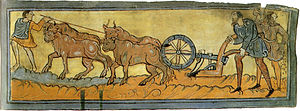
English ploughmen, c. 1000
Early medieval European dress, from near 400 A.D. to 1100 A.D., inverse very gradually. The chief feature of the menstruation was the meeting of tardily Roman costume with that of the invading peoples who moved into Europe over this period. For a period of several centuries, people in many countries dressed differently depending on whether they identified with the old Romanised population, or the new populations such every bit Franks, Anglo-Saxons, Visigoths. The most hands recognisable difference between the two groups was in male person costume, where the invading peoples generally wore brusk tunics, with belts, and visible trousers, hose or leggings. The Romanised populations, and the Church, remained faithful to the longer tunics of Roman formal costume, coming below the knee, and often to the ankles. By the end of the period, these distinctions had finally disappeared, and Roman dress forms remained mainly as special styles of clothing for the clergy – the vestments that accept changed relatively picayune up to the present mean solar day.[1]
Many aspects of clothing in the period remain unknown. This is partly considering merely the wealthy were buried with clothing; it was rather the custom that most people were buried in burial shrouds, also chosen winding sheets.[2] Fully dressed burial may have been regarded equally a pagan custom, and an impoverished family unit was probably glad to keep a serviceable prepare of clothing in employ.[3] Clothes were expensive for all except the richest in this menses.
History [edit]

For many centuries people had worn simply sewn T-shaped tunics that they fabricated themselves. It was only in the 11th century that a professional person tailor class began to develop techniques to make fitted fashions. Some progress was made simply 12th century fashions were usually too tightly fitted, and sleeves were too loose and likewise long.[four]
Materials [edit]
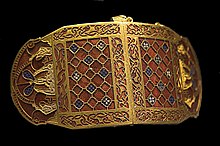
Shoulder-clasps for an Anglo-Saxon king of the 7th century, constitute at Sutton Hoo
Apart from the elite, nearly people in the menstruum had depression living standards, and dress were probably home-made, usually from cloth fabricated at a village level, and very simply cut. The aristocracy imported silk cloth from the Byzantine and later Muslim worlds, and also probably cotton. They also could afford bleached linen and dyed and simply patterned wool woven in Europe itself. But embroidered decoration was probably very widespread, though not usually detectable in art. Most people probably wore only wool or linen, ordinarily undyed, and leather or fur from locally hunted animals.
Archaeological finds accept shown that the aristocracy, especially men, could own superb jewellery, well-nigh commonly brooches to spike their cloak, but also buckles, purses, weapon fittings, necklaces and other forms. The Sutton Hoo finds and the Tara Brooch are two of the most famous examples from Ireland and Britain in the centre of the period. In France, over iii hundred gilded and jewelled bees were found in the tomb of the Merovingian king Childeric I (died 481; all merely two bees accept since been stolen and lost), which are thought to have been sewn onto his cloak.[5] Metalwork accessories were the clearest indicator of high-ranking persons. In Anglo-Saxon England, and probably about of Europe, just free people could carry a seax or knife, and both sexes normally wore one at the waist, to use for all purposes.
Decoration [edit]
Both men's and women'due south wear was trimmed with bands of decoration, variously embroidery, tablet-woven bands, or colourful borders woven into the fabric in the loom.[six] [vii] The famous Anglo-Saxon opus anglicanum needlework was sought-after as far away as Rome. Anglo-Saxons wore decorated belts.
Male clothes [edit]
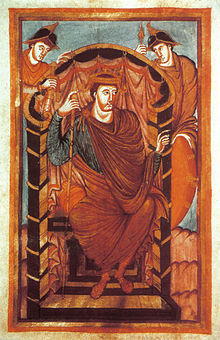
King Lothair I is shown in a cloak fastened on i shoulder worn over a long-sleeved tunic and cantankerous-gartered hose, c. 850
The chief garment was the tunic — generally a long fabric panel, folded over with a neck-pigsty cut into the fold, and sleeves attached. It was typical for the wealthy to display their affluence with a longer tunic made of finer and more colorful cloth, even silk or silk-trimmed. The tunic was usually belted, with either a leather or strong cloth chugalug. Depending on climate, trousers were tailored either loose or tight (or not worn at all if the weather was warm). The most basic leggings were strips of cloth wound round the leg, and held in place past long laces, presumably of leather, which is called cross-gartering. This may have been done with loose-fitting trousers besides. Tighter-fitting hose were too worn.
Over this a sleeved tunic was worn, which for the upper classes gradually became longer towards the end of the flow. For peasants and warriors it was ever at the knee or higher up. For winter, outside or formal dress, a cloak or mantle completed the outfit. The Franks had a characteristic short cape called a "saie", which barely came to the waist. This was attached on the left shoulder (so as not to impede sword strokes) past a brooch, typically a fibula and after a round brooch on the Continent, and virtually always a circular one for Anglo-Saxons, while in Ireland and Scotland the detail mode of the penannular or Celtic brooch was almost common. In all areas the brooch could exist a highly elaborate piece of jewellery in precious metal at the top of society, with the most elaborate Celtic brooches, like the Tara Brooch and Hunterston Brooch, perhaps the nigh ornate and finely made of all. The "cappa" or chaperon, a one-piece hood and cape over the shoulders was worn for common cold weather, and the Roman straw hat for summer fieldwork presumably spread to the invading peoples, as it was universal by the High Eye Ages. Shoes, not always worn by the poor, were mostly the simple turnshoe – typically a cowhide sole and softer leather upper, which were sewn together, and then turned within out.
Charlemagne [edit]
The biographers of Charlemagne tape that he always dressed in the Frankish manner, which ways that he wore similar if superior versions of the wearing apparel of better-off peasants over much of Europe for the subsequently centuries of the flow:
He used to wearable the national, that is to say, the Frank dress: side by side to his pare a linen shirt and linen breeches, and above these a tunic fringed with silk; while hose attached by bands covered his lower limbs, and shoes his feet, and he protected his shoulders and breast in wintertime by a close-fitting coat of otter or marten skins..... He despised foreign costumes, yet handsome, and never allowed himself to be robed in them, except twice in Rome, when he donned the Roman tunic, chlamys, and shoes; the first time at the asking of Pope Hadrian, the second to gratify Leo, Hadrian's successor. — Einhard
No English language monarch of the time had his apparel habits recorded in such particular. The biographers as well tape that he preferred English wool for his riding-cloaks (sagæ), and complained to Offa of Mercia about a tendency to make cloaks imported into Frankia impractically curt. A slightly later narrative told of his dissatisfaction with the short cloaks imported from Frisia: "What is the apply of these pittaciola: I cannot cover myself up with them in bed, when riding I cannot defend myself against wind and rain, and getting down for Nature's call, the deficiency freezes the thighs".[8] He was slightly over half dozen feet tall.
Clergy [edit]
At the beginning of this flow the clergy mostly dressed the aforementioned as laymen in post-Roman populations; this inverse completely during the period, as lay dress inverse considerably but clerical dress inappreciably at all, and by the end all ranks of clergy wore distinctive forms of dress.
Clergy wore special short hairstyles called the tonsure; in England the choice between the Roman tonsure (the peak of the head shaved) and the Celtic tonsure (only the front of the head shaved, from ear to ear) had to exist resolved at the Synod of Whitby, in favour of Rome. Wealthy churches or monasteries came during this period to apply richly decorated vestments for services, including opus anglicanum embroidery and imported patterned silks. Various forms of Roman-derived vestment, including the chasuble, cope, pallium, stole, maniple and dalmatic became regularised during the menstruum, and by the cease there were complicated prescriptions for who was to vesture what, and when. To a large extent these forms of vestment survive today in the Catholic and (even more than bourgeois) Anglican churches. The aforementioned process took place in the Byzantine earth over the same catamenia, which again retains early medieval styles in Eastern Orthodox vestments.
Secular (i.east. non-monastic) clergy normally wore a white alb, or loose tunic, tied at the waist with a string (formally chosen a cincture), when not conducting services.[nine] Senior clergy seem always to accept fastened their cloaks with a brooch in the centre of their breast, rather than at their right shoulder similar laymen, who needed their sword-arm unencumbered.
Female person dress [edit]
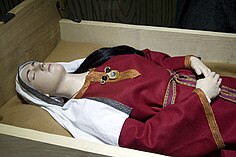
Reconstruction from Kirkleatham Museum of the body of the Street Business firm "Saxon Princess" in her bed. seventh Century AD, Northumbria, England
Women'south clothing in Western Europe went through a transition during the early medieval menstruation as the migrating Germanic tribes adopted Late Roman symbols of authority, including dress. In Northern Europe, at the beginning of the period effectually 400 - 500 Advertising in Continental Europe and slightly later in England, women'southward clothing consisted at least one long-sleeved tunic fitted at the wrists and a tube-like garment, sometimes called a peplos, worn pinned at the shoulders.[10] This garment was carried with the Germanic Migrations to Iberia and Southern Europe. These garments could be decorated with metal applique, embroidery, and woven bands.
After around 500 Advertizing, women's wear moved towards layered tunics. In the territories of the Franks and their eventual client tribes the Alemanni and Bavarii, as well as in East Kent, women wore a long tunic as an inner layer and a long coat, closed in the front with multiple brooches and a belt, as an outer layer.[11] An instance of this can be seen in the interpretations of the grave of Queen Arnegunde.[12] Not all graves identified as female contain the brooches necessary to close the forepart of the "coat apparel", indicating that not all women wore that mode, or at least that not all women were buried in that style. The brooches may have been also expensive for most women.
The women of later Anglo-Saxon England, exterior of E Kent, mostly wore an ensemble of multiple layered tunics. These women were particularly well known for their embroidery and may take decorated their wear with silk and wool embroidery or woven bands. These tunics are oftentimes interpreted as having a style of neckline called a "keyhole neckline" that may accept facilitated breast-feeding. This neckline would have been closed with a brooch for modesty and warmth. In later Anglo-Saxon England, in that location is visual show for a large poncho-like garment that may have been worn by noble or royal women.

An interpretation of the Scandinavian Apron Wearing apparel from Stavanger, Norway
The most famous garment of early on medieval Scandinavia is the so-chosen Apron Dress (likewise called a trägerrock, hängerock, or smokkr). This may have evolved from the peplos of the early Germanic Iron Age. The garment is often interpreted every bit a tube shape (either fitted or loose) that is worn with straps over the shoulder and large brooches (sometimes called "turtle brooches") at the upper chest.[xiii] Examples of appliqued silk bands used equally decoration take been found in a number of graves.[13] Not all graves identified as belonging to women contain the brooches that typify this type of garment, indicating that some women wore a unlike mode of clothing. There is evidence from Dublin that at to the lowest degree some Norse women wore caps or other head-coverings, it is unclear nonetheless how pervasive this practice was.[14]
On all top layers, the neckline, sleeves, and hems might be decorated with embroidery, tablet weaving, or appliqued silks, very richly so for the upper classes. Hose or socks may take been worn on the legs.[15] Veils or other caput coverings appear in fine art depicting northern European women commencement with the Romans, yet this is not universal.[sixteen] More pervasive employ of headcoverings, especially for married women, appears to follow the Christianization of the various Germanic tribes. Fur is described in many classical accounts of the Germanic tribes merely has not survived well in archaeological remains, making it difficult to translate how and where it was used in female person clothing.[17] In all regions, garments were primarily made out of wool and linen, with some examples of silk and hemp.
Regional variation [edit]
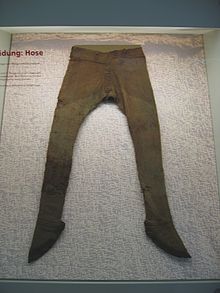
Barbaric trousers, from Thorsberg moor, a bog in Northern Germany, carbon-dated to the 4th century, though in terms of manner they could come from any point in the post-obit thousand years.
Areas where Roman influence remained potent include most of Italia except the North, South-Western France, as far north as Tours, and probably cities like Cologne in Germany. Iberia was largely ruled by the Moors in the later function of the period, and in whatever case had received rather different influences from the Visigoths compared to other invading peoples; Spanish dress remained distinctive well later on the stop of the period. The Visigothic Kingdom of Toulouse also ruled the South and West of France for the offset two centuries of the flow.
Early on Anglo-Saxon women seem to take had a distinctive form of tubular dress, fastened on the shoulder with brooches, and belted. This way matches some German dresses from much before in the Roman period. After about 700, which roughly coincides with the general conversion to Christianity, they adopted the full general Continental style.[eighteen]
The pagan Vikings, especially the women, dressed rather differently from nigh of Europe, with uncovered female hair, and an outer dress made of a unmarried length of cloth, pinned with brooches at both shoulders. Under this they wore a sleeved undergarment, possibly with an intervening wool tunic, especially in winter, when a jacket may take been added as a concluding top layer.[xix]
See also [edit]
- Anglo-Saxon dress
- Anglo-Saxon brooches
- Early Middle Ages
- Byzantine clothes
- Byzantine silk
- Gaelic wearable and way
- English medieval clothing
- History of Western manner
Notes [edit]
- ^ Piponnier & Mane, pp. 114–xv.
- ^ Piponnier & Mane, p. 112.
- ^ Piponnier & Mane, pp. 10–xi.
- ^ Scott, Margaret (2018). [}https://world wide web.google.com/books/edition/Fashion_in_the_Middle_Ages/8aRuDwAAQBAJ Fashion in the Middle Ages]. J. Paul Getty Trust. p. 23.
- ^ University of Chicago article and picture show; Large motion picture from Gallica
- ^ Owen-Crocker, Gale R., Apparel in Anglo-Saxon England, pp. 309–15.
- ^ Østergård, Else, Woven into the Globe: Textiles from Norse Greenland
- ^ ... ad necessaria naturæ tibiarum congelatione deficio: quoted in H. R. Loyn, Anglo-Saxon England and the Norman Conquest, 2d ed. 1991:88–89..
- ^ Piponnier & Mane, p. 114.
- ^ R., Owen-Crocker, Gale (2004). Dress in Anglo-Saxon England (Rev. and enl. ed.). Woodbridge [England]: Boydell Printing. pp. 42–43. ISBN184383572X. OCLC 56050995.
- ^ Penelope., Walton Rogers (2007). Cloth and clothing in early Anglo-Saxon England, AD 450-700. Quango for British Archaeology. York: Quango for British Archaeology. ISBN978-1902771540. OCLC 67873792.
- ^ "INFOGRAPHIC – The Arnegunde Project – Suvia's Letters". alfalfapress.com . Retrieved 2017-12-05 .
- ^ a b "Viking women: Clothing: Aprondress (smokkr)". urd.priv.no . Retrieved 2017-12-05 .
- ^ Wincott Hecket, Elizabeth (2002). "Irish Viking Historic period silks and their place in Hiberno Norse society". Digital Eatables at the University of Nebraska . Retrieved December v, 2017.
- ^ R., Owen-Crocker, Gale (2004). Dress in Anglo-Saxon England (Rev. and enl. ed.). Woodbridge [England]: Boydell Press. pp. 83–84. ISBN1843830817. OCLC 56050995.
- ^ R., Owen-Crocker, Gale (2004). Wearing apparel in Anglo-Saxon England (Rev. and enl. ed.). Woodbridge [England]: Boydell Printing. pp. 78–82. ISBN1843830817. OCLC 56050995.
- ^ R., Owen-Crocker, Gale (2004). Dress in Anglo-Saxon England (Rev. and enl. ed.). Woodbridge [England]: Boydell Printing. p. 76. ISBN1843830817. OCLC 56050995.
- ^ Payne, p. 148.
- ^ Payne, p. 153.
References [edit]
- Østergård, Else, Woven into the Earth: Textiles from Norse Greenland, Aarhus Academy Press, 2004, ISBN 87-7288-935-7
- Owen-Crocker, Gale R., Dress in Anglo-Saxon England, revised edition, Boydell Press, 2004, ISBN 1-84383-081-7
- Payne, Blanche; Winakor, Geitel; Farrell-Brook, Jane: The History of Costume, from the Ancient Mesopotamia to the Twentieth Century, 2nd Edn, pp. 1–28, HarperCollins, 1992. ISBN 0-06-047141-seven
- Piponnier, Françoise, and Perrine Mane; Dress in the Middle Ages; Yale Up; 1997; ISBN 0-300-06906-5
- Youngs, Susan (ed), "The Work of Angels", Masterpieces of Celtic Metalwork, 6th–9th centuries AD, 1989, British Museum Press, London, ISBN 0-7141-0554-half-dozen
Further reading [edit]
- Sylvester, Louise Thousand., Mark C. Chambers and Gale R. Owen-Crocker (eds.), 2014, Medieval Dress and Textiles in Britain: A Multilingual Sourcebook Woodbridge, Suffolk and Rochester, NY Boydell & Brewer. ISBN 978 1 84383 932 3.
0 Response to "European Fashion in the Early Middle Ages"
Post a Comment