How Small Oline Fashion Brands Work
Illustration by Diego Blanco
The fashion industry is no stranger to innovation. 2PM reports that 13 of the acme 20 DTC brands are in the manner and apparel industry. Brands similar Skims, Allbirds, and Gymshark make the shortlist, proving the crushing power way brands hold in the ecommerce infinite.
Digital innovation, rising globalization, and changes in consumer spending habits have catapulted the fashion industry into the midst of seismic shifts. Simply, no thanks to the accelerated retail apocalypse caused past the coronavirus, the fashion sector is more unpredictable than ever.
This guide shares the statistics, trends, and strategies shaping the ecommerce fashion marketplace in 2022 and beyond, giving y'all an updated look on where we are and where we're heading.
- Industry-wide data
- The COVID impact
- Habiliment and apparel
- Shoes segment
- Accessories and bags
- Jewelry and luxury
- Ecommerce fashion industry: trends and strategies for 2022
Ecommerce style industry: statistics
1. Industry-broad data
Co-ordinate to Statista, the ecommerce mode industry's compound almanac growth charge per unit (CAGR) is tipped to reach 14.2% between 2017 and 2025, with the industry hitting a $672.71 billion valuation past 2023.
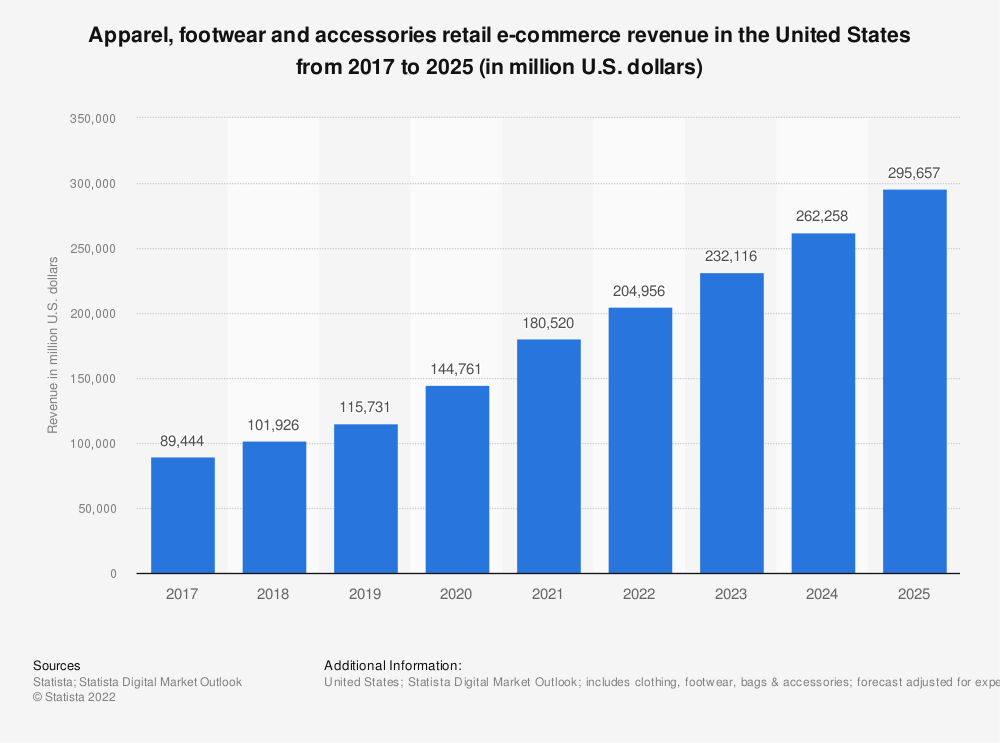
Sales of dress, footwear, and accessories catapulted in 2021, hitting $180.5 billion in the U.s. alone. That's tipped to grow by thirteen% this year, with consumers set to spend $204.nine billion on fashion items online.
Driving this growth are five notable opportunities:
- Expanding global markets exterior the W
- Increasing online access and smartphone penetration
- Emerging worldwide centre classes with dispensable income
- Harnessing the power of glory and influencer culture
The biggest threats to established brands include:
- The death of make loyalty due to market saturation
- Pressure from consumers to apply ethically sourced and green manufacturing materials
- Technological advancements with virtual worlds, such as NFTs and the metaverse
Nosotros'll get into strategies to combat these issues later. For now, let's examine how these large numbers play out in industry sub-verticals.
two. The COVID impact
The coronavirus pandemic wreaked havoc on the concluding few years' fashion ecommerce predictions. When lockdowns were enforced globally in March 2020, 27% of The states consumers said they planned to spend "somewhat" or "a lot" less on luxury and fashion items than they had budgeted prior.
Despite this, McKinsey named it the "perfect tempest for manner marketplaces." Brands similar Zalando reported a 32% to 34% growth in gross merchandise value (GMV) during the second quarter of 2020. Fast-way brand Shein saw its valuation double to $xxx billion, making it the world'southward largest online-only fashion retailer.
One branch of mode retail that has taken off is athleisure. Athleisure'south market size was valued at $155.2 billion in 2018—a figure that's set only to ascension.
Casualwear remains dominant on Amazon, with athleisure predicted to take a CAGR of 6.7% from 2019 to 2026 and reach $257.1 billion. The loungewear and sleepwear market shows similar signs of growth, poised to increment past $nineteen.five billion between 2020 to 2024.
The issue? Fashion brands with an ecommerce store maintain a stronghold in athleisure, like Nike and Lululemon, have reported incredible growth over the class of the pandemic.
3. Vesture and wearing apparel
Lower digital barriers to entry for all clothing merchants offer the opportunity to market, sell, and fulfill orders globally and automatically. Every bit a result, worldwide revenue and revenue per user (ARPU) are both projected to grow.
In the U.s. alone, the apparel and accessory industries accounted for 29.5% of all ecommerce sales in 2021. In Europe, it's expected that past 2025, each consumer will spend $999 on manner-related items over the course of a year.
4. Shoes segment
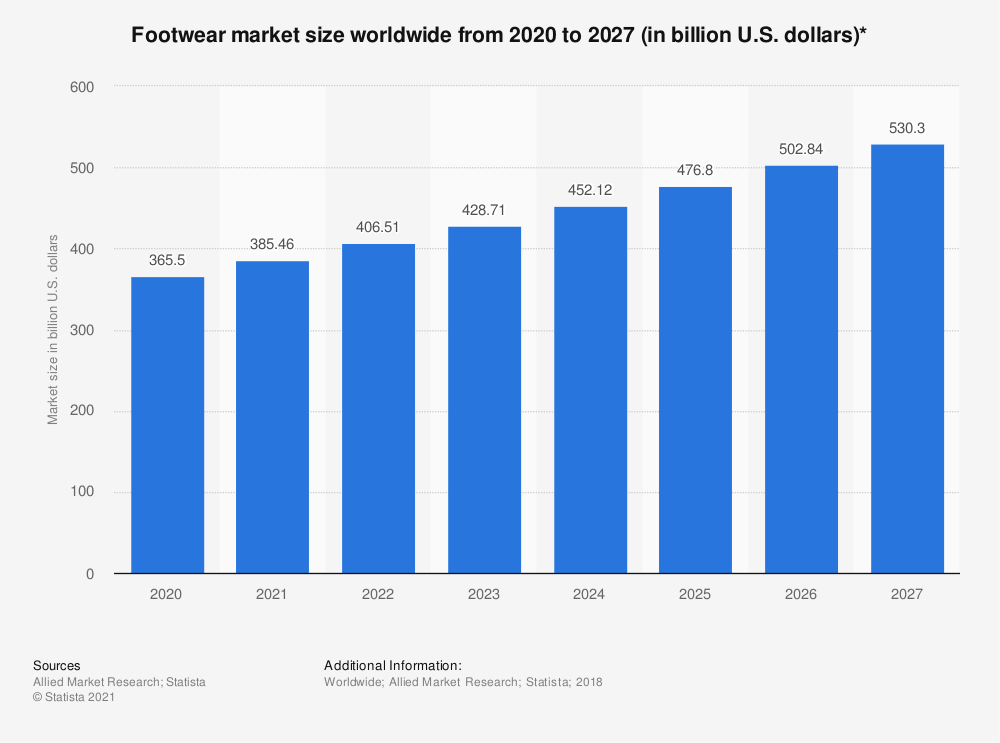
As a segment of ecommerce fashion, the shoe manufacture saw similar peaks in market value. In global market place size, the footwear segment will increase from $365.5 billion in 2022 to $530.three billion in 2027.
Asia is dominating this segment, holding 54% of the global footwear market (compared to just 14.8% for Europe and N America, respectively).
Athletic footwear is too a growing segment, tipped to generate $63.five billion in 2023—a 23% increment from the $51.4 billion valuation in 2020.
5. Accessories and bags
Non surprising, the bags and accessories segment—although notwithstanding growing at a stronger rate—will likewise come across double-digit growth. The mode accessory segment volition accept a CAGR of 12.3% between 2016 and 2026, with Asia-Pacific beingness the fastest growing market.
Those projections actually brand bags and accessories one of the healthiest segments of ecommerce style, despite its absolute numbers being the smallest.
vi. Jewelry and luxury
In 2020, the global jewelry marketplace was valued at a full of $228 billion. It'due south forecasted to achieve $307 billion past 2025, with ecommerce sites expected to facilitate 20.8% of sales in the luxury appurtenances category this year. Luxury watches are set to take a huge slice of that revenue—customers will spend $9.three billion on them in 2025.
The growth (despite coronavirus-related recessions) mirrors other financial crises. McKinsey predicted that consumers will "return more apace to paying full price for quality, timeless appurtenances, as was the example afterward the 2008–2009 fiscal crisis."
Increasing affluence in Asia-Pacific and in the Center Due east collection upward the average revenue per luxury expert consumer to $313. Despite luxury goods sales seeing sluggish growth, at 3.iv% annually, McKinsey forecasts signal that ecommerce could triple in sales over the next decade—reaching €70 billion ($79.5 billion) past 2025.
The biggest threat is the affordable luxury market: Should the industry offer luxury goods at multiple price points to abound the market overall? Or will affordable luxury dilute or erode the high-cease luxury market place—dampening consumer conviction that what they are ownership is "true luxury"?
Ecommerce way manufacture: trends and strategies for 2022
The above data points offer a wealth of growth opportunities for fashion and apparel retailers—despite the huge shifts in consumer behavior, global merchandise, and "normal" day-to-mean solar day lives for millions around the world.
Below are some of the latest ecommerce trends that you lot can piece of work into your long-term fashion sales strategy.
- Personalization is a balancing act
- Into the metaverse
- Make-building over paid ads
- Sustainability at the forefront
- Social commerce
- The transition back to brick-and-mortar
Personalization is a balancing act
Personalization has long been hailed as the secret of modern ecommerce. By showing items a shopper was previously interested in, or retargeting them based on the activity they've had with your ecommerce website, yous're providing a tailored online shopping experience—ane that convinces them to buy.
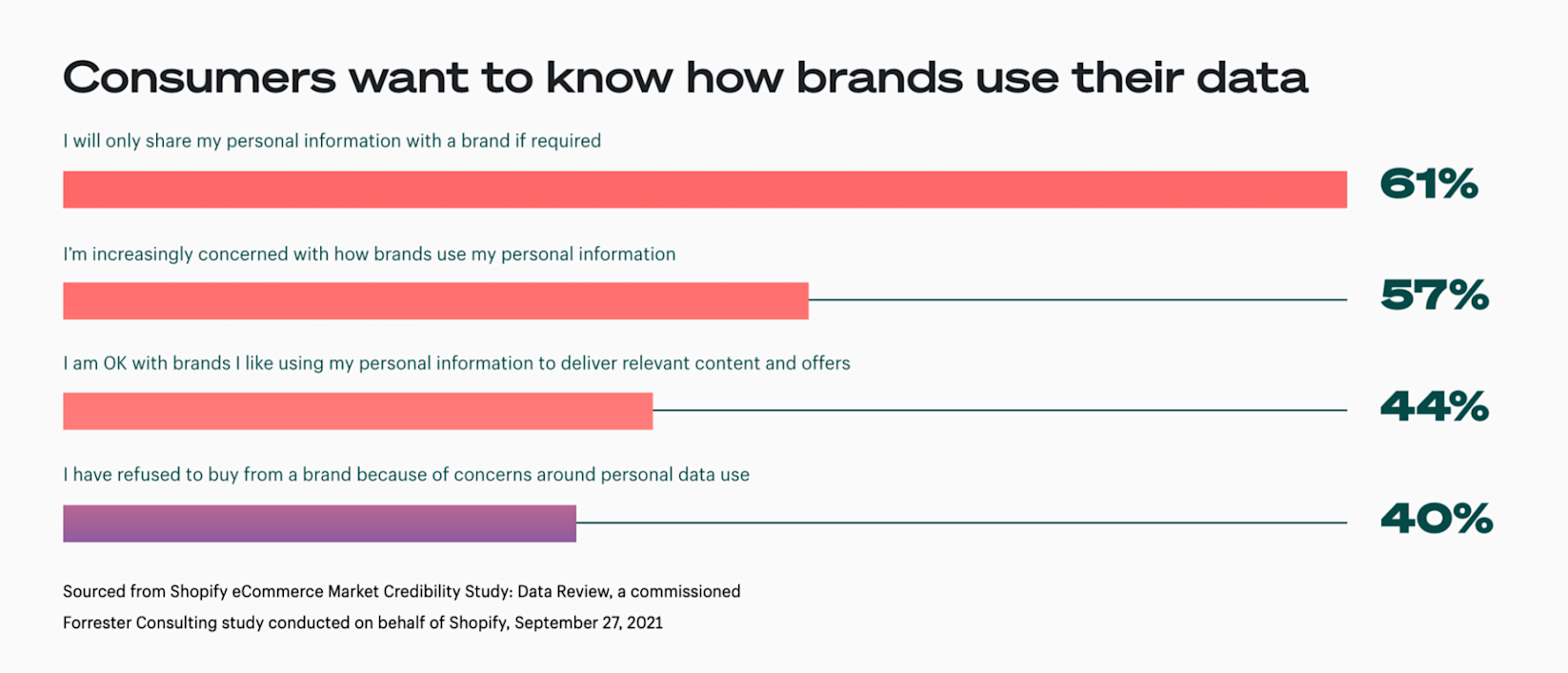
Our research shows that 44% of customers are OK with brands using their personal information to personalize messaging and improve the customer experiences, such every bit product recommendations. Simply there'southward a fine line.
Online shoppers are increasingly concerned about their privacy. Besides much personalization tin be creepy, hence why brands that over-personalize are iii times more probable to be abandoned by shoppers.
Civilization Kings is the perfect example of how fashion ecommerce brands tin can rest under- and over-personalization. Instead of customizing the experience downwardly to "first name" tags on the website, it congenital four global storefronts to sell in different currencies. The result? More half of the fashion brand's revenue at present comes from its ecommerce business concern.
I believe nosotros'll run into more local brands branching out and offer customized shopping experiences for international customers to remain competitive. This will include things like geo-targeted domains, pricing in local currency and local product aircraft, with the aid of third-party distribution or company endemic warehouses."
—Leanne Lee, Marketer at Blue Bungalow
Into the metaverse
The definition of "metaverse" is open up to estimation. The not-quite-defined promise of virtual societies is nevertheless in development, though the idea is that people tin can conduct daily activities—like connecting with friends, playing a game, and purchasing products—through an online, virtual world.
1 type of item that functions both in and out of the metaverse are non-fungible tokens (NFTs)—unique digital tokens that can but be owned past ane person, usually paid for in virtual currency like crypto. Information shows $87.03 million was spent on NFTs on January 1, 2022, alone.
Celebrities similar Reese Witherspoon were mocked for predicting, "In the (most) hereafter, every person will take a parallel digital identity. Avatars, crypto wallets, [and] digital appurtenances volition be the norm."
In everything we practise, nosotros're helping the customer imagine. Nosotros desire them to imagine being the human in every picture. To imagine u.s.a. being their stylist. To imagine, 'That could exist me wearing those clothes.' We're not so much curating content every bit curating imagination."
—Kevin Dao, Co-founder and CEO/CCO at ORO LA
In reality, fettle apparel brands like Under Armour are experimenting with NFTs in the retail space. Its Steph Curry collaboration reproduced shoes the basketball star wore when he broke the NBA tape as all-time elevation three-bespeak shooter.
Digital NFTs were released aslope the physical product launch. Owners of the NTFs could virtually wearable the shoes in three metaverses: Decentraland, The Sandbox, and Gala Games.
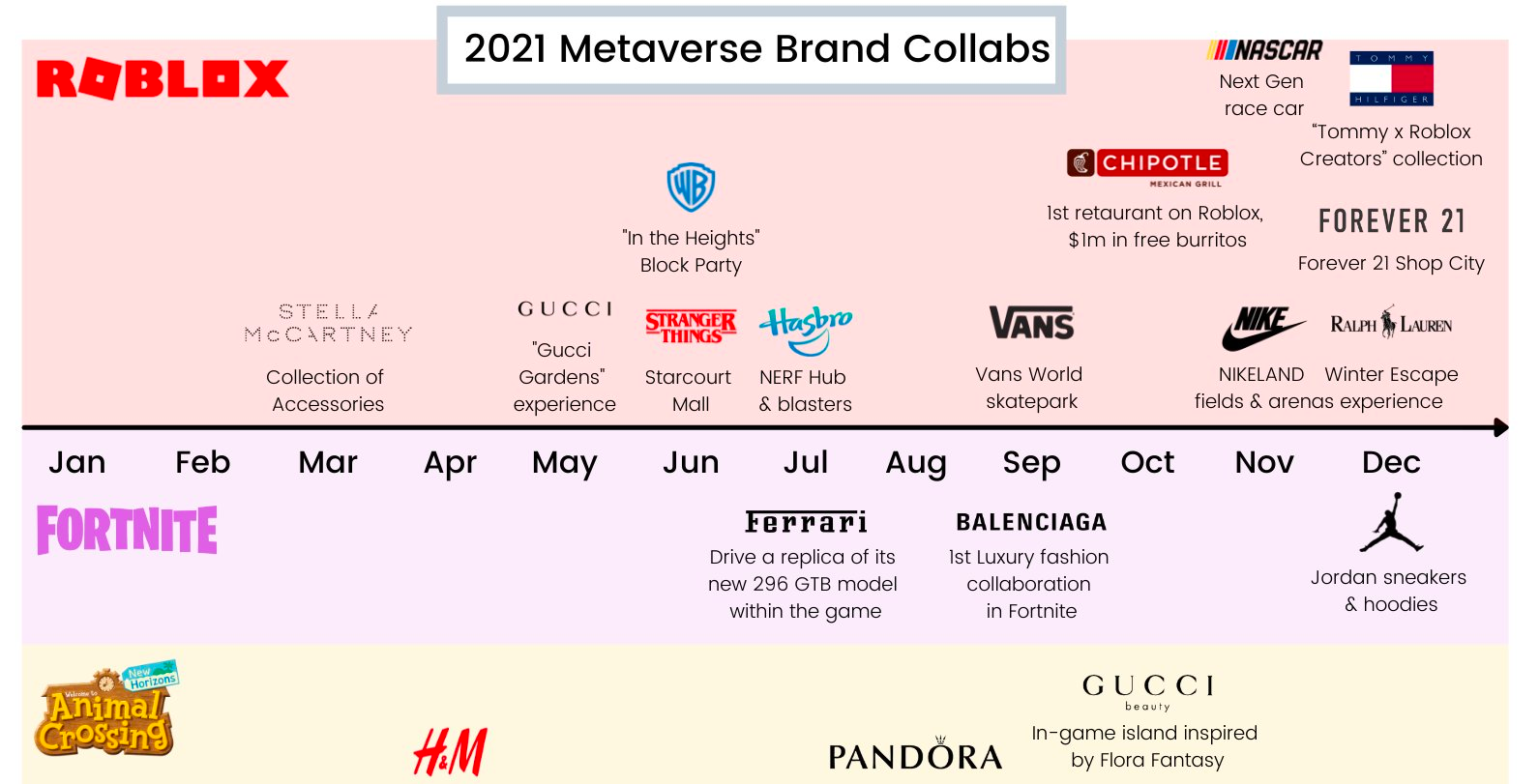
Retailer Forever 21 partnered with Roblox to create virtual stores in its metaverse, appropriately named the Forever 21 Shop City. Players run the virtual store as if it was their own, and buy merchandise for their avatar through the game.
With Forever 21 Store City, our goal is to expand how we engage with customers, extending our presence and product in new ways."
—Katrina Glusac, chief merchandising officeholder at Forever 21
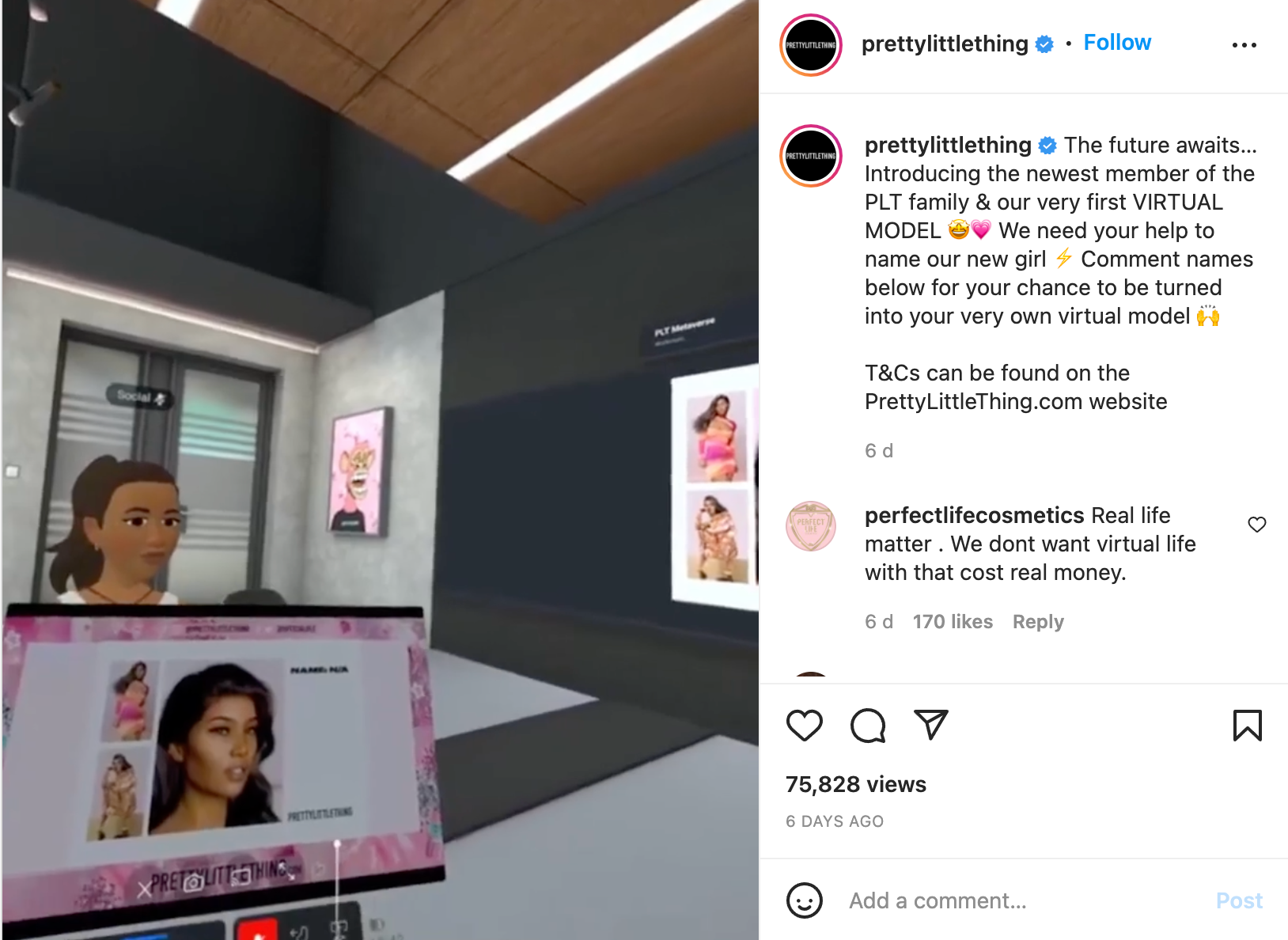
Fast-way retailer PrettyLittleThing also recently began showcasing products on virtual models. The make posted the news to its Instagram page, turning its new "avatar in the metaverse" concept into a competition to spark conversation.
But like Fortnite community inspired Balenciaga's designs, manner companies can movement towards becoming creative collectives. Each collection can have its own identity inside the make universe, reputation, and community. Collectives can focus on the actual production designs and/or on content cosmos, with associated royalties based on particular/content performance, delivering returns to creators in perpetuity and ensuring that a brand attracts the very meridian talent."
—Ana Andjelic, Founder of The Sociology of Business
Brand-building over paid ads
To say fashion ecommerce is saturated would be an understatement. Consumers take more than choice than ever earlier—making it difficult to bulldoze loyal customers back to ane detail online shop.
Unfortunately, that means brands are competing against thousands of competitors when advertising their products to their target market. Some 41% of brands plan to increase their investment in paid search. This rush of budget meant that between the second and tertiary quarters of 2021, the cost per click (CPC) of paid search ads increased by fifteen%.
It's an increasingly dour picture when combined with the "death of the cookie." Technology giants like Google plan to restrict brands from collecting cookies in its browser by 2023. Some 28% of applied science decision makers wait this change in regulation to hinder their 2022 growth goals.
One culling to expensive advertising and limited client data? Make building. Studies show companies that invest in branding see more organic acquisition and customer retentiveness rates. They also find it easier to increase profits since customers of strong brands are more than receptive to cost hikes.
One apparel make leaning into this strategy is Noémie. Yuvi Alpert, its founder, Artistic Director, and CEO, says the make balances both performance marketing and make edifice: "We wanted to move abroad from typical short form ad that did non depict an emotional connection to our products, which is why we diversified our promotions and the channels we utilized to feature narrative ads.
"Narrative or storytelling promotions had share rates of up to 20%, and in recognizing this fact, we decided to research the best ways to implement that strategy.
"By creating storylines nearly our customers, and so placing those in content rich formats such as blogs, newsletters, and emails, we found dramatic increases in engagement rates over the typical imprint ads or short videos on social media.
"In improver, they were far more toll effective and could easily be repurposed. Past moving to a storytelling technique, we increased engagement rates while bringing downward our CPA."
Sustainability at the forefront
The mode manufacture is no stranger to criticism. Fast-fashion brands especially are (sometimes rightly) chastised for the methods they use to industry and produce inventory.
In light of these criticisms making mainstream news, plus consumers' increasing delivery to eradicate climate change, some 52% of shoppers say they're more likely to purchase from a company with shared values.
An important value for modern fashion consumers? Sustainability. Statista's research shows 42% of global customers purchase eco-friendly and sustainable products. Certain countries are leading the trend—online shoppers in Vietnam, India, and the Philippines buy sustainable products more often.
With people spending more time online, it is going to facilitate faster exchange of that information [nigh suppliers]. We've go more aware of how things that happen in far flung places bear upon us and the planet. That's been a existent cardinal change we've seen."
—Grace Beverly, Founder of TALA
Purchasing habits are too shifting off the back of the pandemic. Some 65% of customers program to purchase more than durable fashion items, with 71% planning to keep the items they already have for longer. The fashion resale market is booming for this reason—growing 11 times faster than traditional retail and tipped to reach a $77 billion valuation in the side by side five years.
Patagonia is i apparel brand with sustainability rooted in its make values. The retailer actively campaigns for environmental causes, and demonstrates its delivery to sustainability with its Worn Wear programme. Shoppers are encouraged to buy and sell used items instead of buying new.
We're proud to offer our customers a conscious shopping choice with sustainable, affordable pieces that are all handpicked and on trend, but we believe every brand needs to have responsibility, and push themselves to become more circular."
—Kate Peters, Managing Manager of Beyond Retro
Social commerce
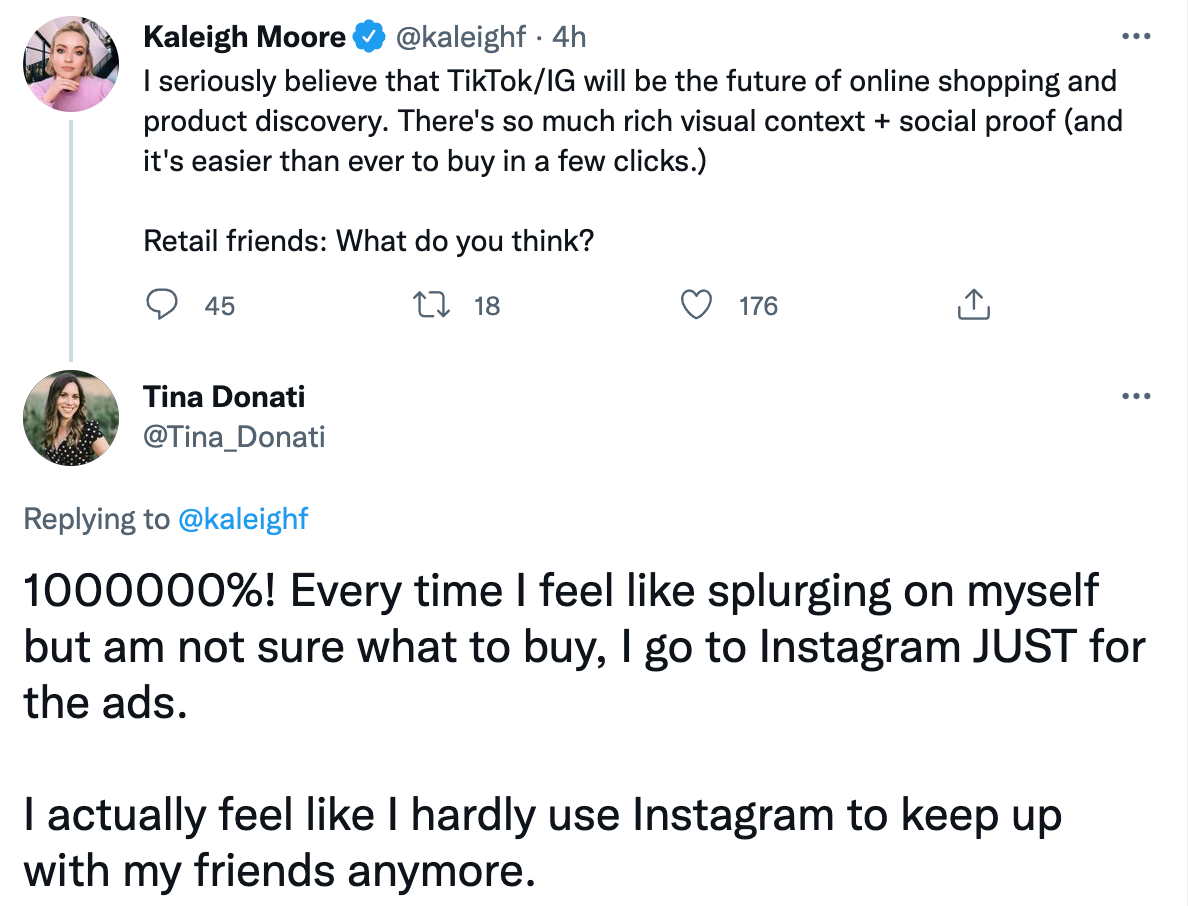
Social media plays an integral function in the ecommerce marketing strategy of many online fashion brands. That's inappreciably surprising—our smartphone habit is out of control. The typical social media user now spends about 15% of their waking life glued to an online networking app.
But the truth is: social media is no longer a identify for shoppers to consume new style trends. Many social media platforms are evolving their business models to facilitate in-app shopping, helping online retailers reach customers actively in the purchasing frame of listen.
Social commerce sales are expected to nearly triple by 2025, with more than one-third of Facebook users planning to make a purchase directly through the platform in 2022.
Unfortunately, almost brands are plagued past a unmarried sin. Andy Crestodina, co-founder of Orbit Media, describes the situation perfectly: "Most branded content is advertising under a thin layer of information or entertainment. Scratch the paint, detect an ad. It'south the brand putting itself first."
Thankfully, fashion and social media are a match made in ecommerce heaven. Even when information technology comes to explicitly "branded" content, and especially on Instagram.
Social media engagement rates for global fashion brands are abysmal:
- Instagram: 0.68%
- Facebook: 0.03%
- Twitter: 0.03%
So, what types of content is working for style brands? Some 46% of consumers desire to watch product videos before they buy. Platforms like TikTok and Instagram are praised for driving sales for large fashion brands since shoppers can visualize the product on a real person. Bonus points if it's a social media influencer they already trust.
Long gone are the days of celebrities beingness only someone you'd come across on TV. Today, anyone with a passion tin can become a celebrity in the social media niche—partly due to the rise of entertainment platforms like Instagram, LinkedIn, and Twitch.
Beyond influencer marketing on social media, multi-channel ecommerce integrates native selling off site to build directly buying paths in the places your audition spends their time. Social media platforms are creating their own commerce features—like Shopping on Instagram, Facebook Shops, buyable pins on Pinterest, and more.
Livestream shopping is as well in its heyday. Nordstrom launched its own livestream shopping channel terminal year. It'due south in good company: 81% of companies plan to increase or maintain their investment in livestream selling to drive sales over the coming year.
Why? Considering online brands are seeing conversion rates of up to 30% through Facebook and Instagram livestreams, along with lower product return rates.
My prediction is that in a couple years, the hottest role for a brand to hire is going to exist a head of alive shopping."
—Kevin Gould, Co-founder of Glamnetic
The transition dorsum to brick-and-mortar
The shopping experience is more complex than always—especially in the fashion space. Some 22% of online returns happen because the product ordered online looks differently in the flesh. It's this never-ending challenge that'south driving many fashion brands back into traditional retail.
The future is neither ecommerce or retail. It'due south simply commerce. So the question becomes, 'How exercise you symbiotically integrate both channels?'"
—Hemant Chavan, founder of Brik + Clik
Data compiled in the Hereafter of Commerce report proves omnichannel commerce isn't disappearing anytime soon. Modernistic consumers want both online and offline sales channels—and synergy between the 2:
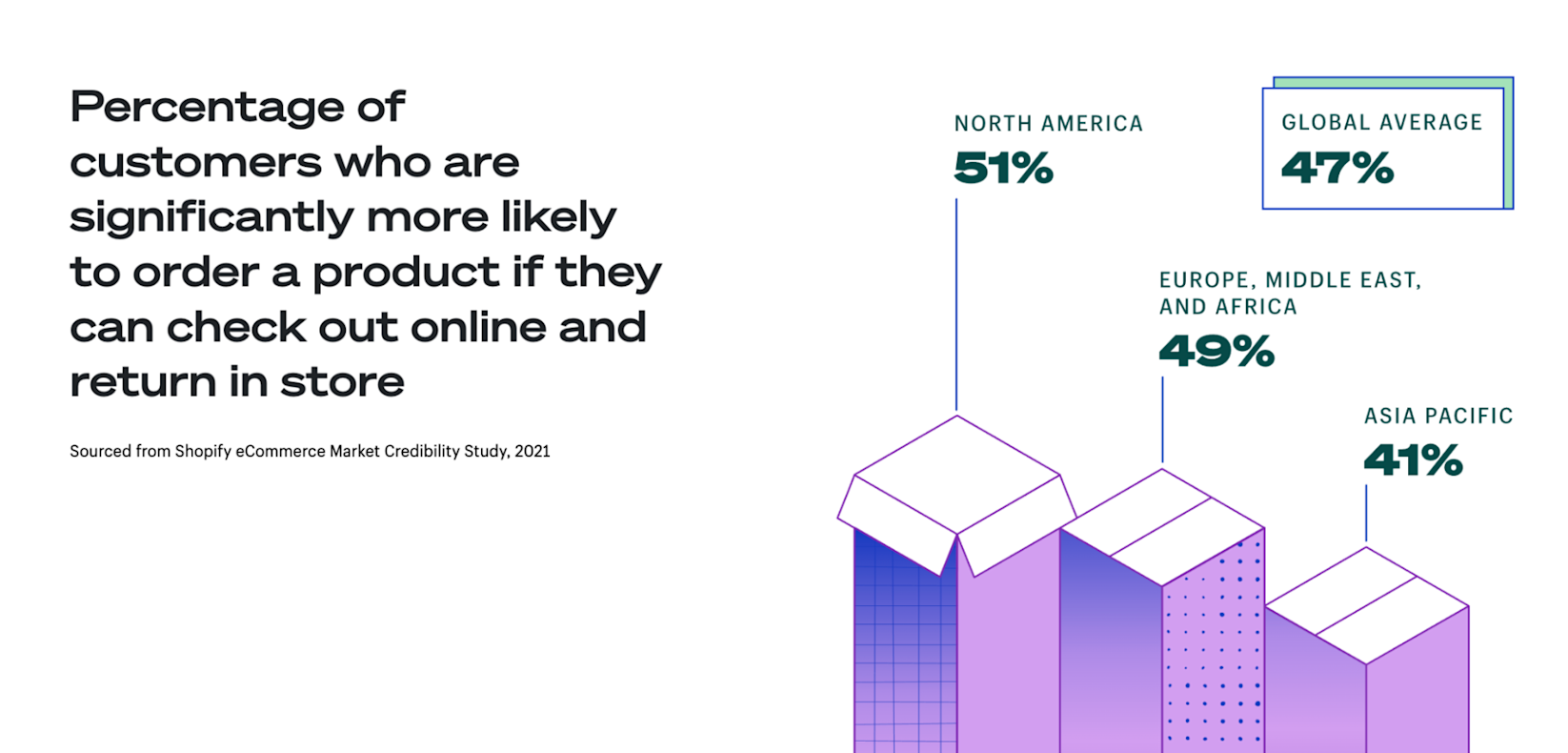
- 54% of consumers are probable to look at a product online and buy it in a concrete store.
- 53% vision themselves doing the opposite: viewing products in-store and ownership information technology online.
- 55% of consumers want to browse products online and bank check what's available in local stores.
- Over 50% of developed shoppers apply BOPIS, with 67% adding actress items to their carts when they can pick them up immediately.
Brands investing in brick-and-mortar retail include Canadian fashion brand SMYTHE, which opened its shop in Toronto. Later on years of experimenting with pop-upwards shops, Gymshark also opened its first permanent flagship store in central London.
"A children's wear retailer I spoke to pivoted from in-store events to virtual shopping events via Zoom during COVID," says Kyle Monk, Managing director of Insight, British Retail Consortium.
"Of a sudden, they were having i member of staff walking around the store selling products to two to 300 people per call every week, instead of just a few in person. Retailers who thought innovatively and pivoted thrived over the last menses."
It's no wonder 53% of brands are investing in tools that allow them to sell anywhere.
Want more nigh the state of ecommerce manner?
The country of ecommerce style is developing more quickly than ever. What worked two years agone is outdated at present—largely due to consumer preferences changing, values becoming integral to the buy decision, and footfall returning to brick-and-mortar stores.
Read our Future of Commerce report and become the ecommerce trends, insights, and advice yous need to succeed in 2022:
0 Response to "How Small Oline Fashion Brands Work"
Post a Comment